
High on a barren, windswept bluff overlooking the majestic Columbia River Gorge in southern Washington State sits a strange concrete structure of pillars and columns encircling a large stone slab alter. Most motorists speeding along the interstate highway which hugs the great river below do not even know it is there, and only those who are actively looking for it can pick it out from among the other rocky outcroppings and cliffs. In the summer it is blistering hot and brush fires frequently sweep through the area. In the winter the bitter wind is funnelled up the steep gorge, howling fiercely and driving rain and ice sideways before it.
This is the Maryhill Stonehenge.
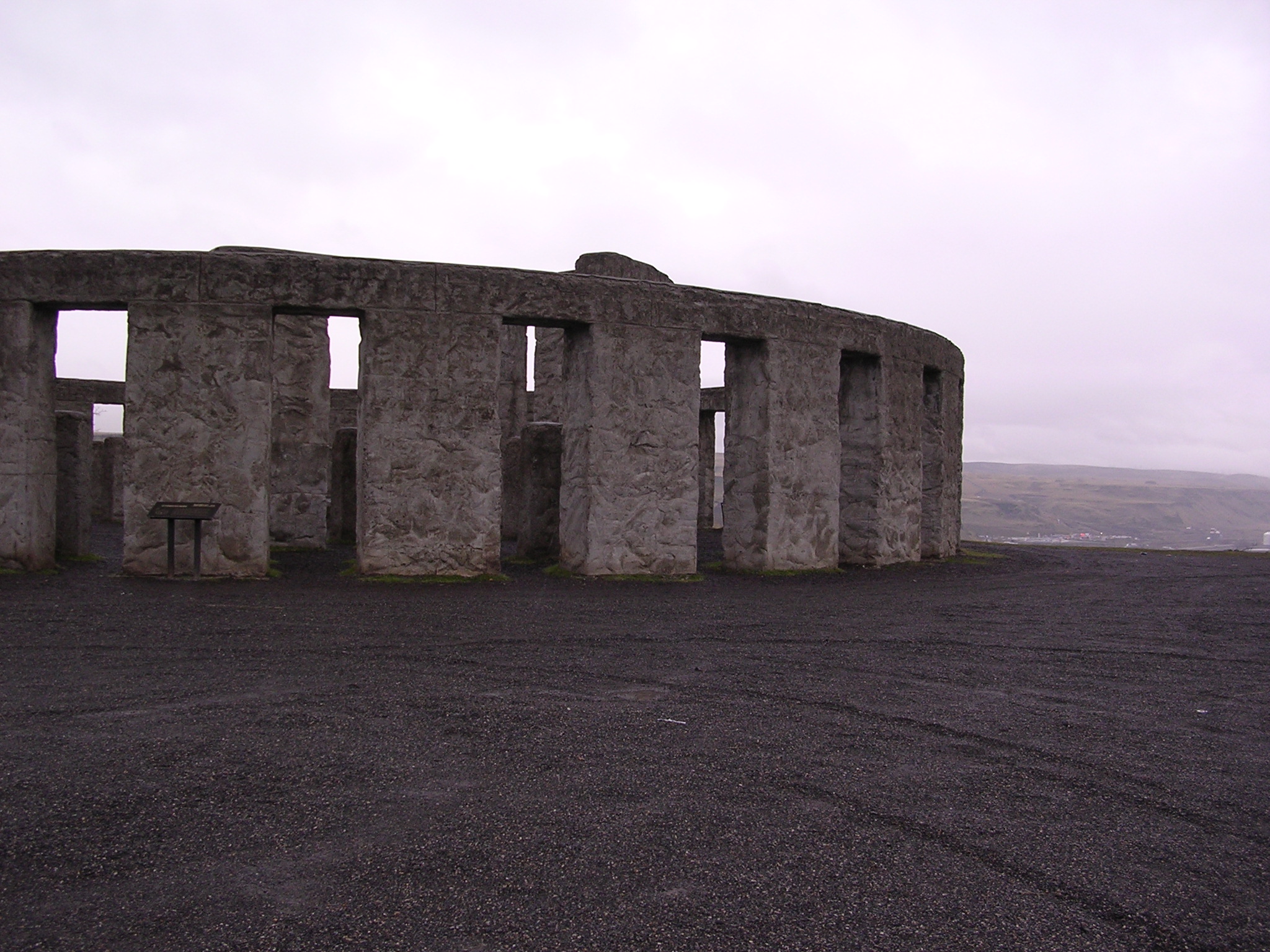
Commissioned in the early 20th century by eccentric businessman Sam Hill, it was the first US memorial dedicated to soldiers who fought and died in WWI. Mr. Hill, a Quaker, believed that the original Stonehenge in Wiltshire had been used by the Druids as a sacrificial site and he wanted his replica to be a reminder that mankind is still being sacrificed to the gods of war. Inscribed with the names of those men who served and died in the war are these words:
“To the memory of the soldiers and sailors of Klickitat County who gave their lives in defense of their country. This monument is erected in hope that others inspired by the example of their valor and their heroism may share in that love of liberty and burn with that fire of patriotism which death alone can quench.”
It seems fitting that this monument was built in such a remote, hostile environment. How many people, I wonder, speed by on the interstate highway below and never give a second thought to the concrete formation standing sentinel on the high promontory above them? It is not someplace you just happen upon unintentionally. You have to make it your destination and drive a considerable distance in order to arrive here. In many ways it is representative of how WWI dwells in the consciousness of the average American – remote, hostile, desolate, something glimpsed from a distance as we speed through our history lessons, a blip between the Civil War and WWII.
Here in the UK it is a different matter altogether.
It is difficult for Americans to fully comprehend the impact which WWI had on the United Kingdom. It is not until you have been here, especially in this year which marks the 100th anniversary of the start of the war, that you begin to realize how much it changed the lives of the people of this nation forever.
In America, our costliest war in terms of loss of life still remains the Civil War in which approximately 620,000 soldiers died. If you add together the number of American military deaths from both WWI and WWII you still do not exceed the number killed in our own, home grown conflict. Contrast that to the United Kingdom where 700,000 soldiers were killed on the battlefields and you can begin to see why WWI looms so large in the hearts and minds of the British people – far more than it does in those of Americans.
I was an odd, history-loving student, and so I remember reading about the assassination of Archduke Ferdinand, reading about the trench warfare, looking at the grainy black and white photographs in my history books showing General Pershing arriving in France; and I remember memorizing a few lines of a poem:
In Flanders fields the poppies blow
Between the crosses, row on row,
That mark our place; and in the sky
Still bravely singing, fly
Scarce heard amid the guns below
~John McCrae
I memorized the poems and learned the dates and the facts, and I looked at the photographs with curiosity and sadness; but for me, and for most Americans I’ve known, WWI did not have the resonating emotional impact which WWII had on the nation. It was a tragic period of history, and anyone who studied the works of Hemingway or Fitzgerald in school realizes that the veneer of innocence was shattered forever. We can feel horror at the great losses on both sides of the conflict, but few of us have a personal connection to that loss. When we look at WWI we primarily see it as the war which paved the way toward WWII and the far-reaching violence and destruction of that conflict, which hit much closer to home.
In my immediate family I cannot think of anyone who served in the Great War, but I can quickly list several who fought and died in WWII. My grandfather was too young to fight in WWI, and the only stories he had to tell were not of battles, but of the mule team requisitioned by the army which was taken away and never seen again. For a poor farming family the loss of those mules had a much more immediate impact on them than the fighting far away in Europe did. My grandfather stared at a photo of that team of mules for a long time when I found it one day while I was going through an old album. He held it delicately by the edges so as not to smudge the image with his fingerprints, and he told me the story. They were good mules, he said, and he always wondered what happened to them. He hoped they didn’t get sent to the front.
My grandfather was not a sentimental sort of man. He’d lived a hard life and some might have thought him a hard man, but he had a gentle side that he kept well hidden which found expression in his love for animals. He looked at that photo of the mules, and I could see the little boy in the old man, mourning the loss of a team of animals over 70 years before.
In a much deeper way the people of the United Kingdom have been mourning the loss of almost an entire generation of young men for 100 years.
At the beginning of the war the men from smaller towns and villages enlisted together and were assured that they would be allowed to fight alongside each other. These Pals Battalions, as they were called, were a recruitment tool used to encourage large groups of men to volunteer, but with the terrible realities of trench warfare they became the means by which disproportionate numbers of men from one small area could be killed in a matter of minutes.
To quote historian Dan Snow:
“Of about 700 “pals” from Accrington, Lancashire who participated in the Somme offensive, some 235 were killed and 350 wounded within just 20 minutes. By the end of the first hour, 1,700 men from Bradford were dead or injured. Some 93 of the approximately 175 Chorley men who went over the top at the same time died.”
This pattern was repeated on an almost unimaginable scale until the “pals” system was finally stopped in 1917. By the end of the war there was not a family in the United Kingdom which had not been forever changed. It was a total war in every sense of the word. Even those soldiers who returned were often scarred, whether physically or emotionally, forever damaged.
The devastation of the Great War becomes immediately apparent when you discover that in England and Wales there are, at most recent count, only 53 so-called Thankful Villages. These are villages in which all of the men who went away to fight returned alive. To this date there have been no thankful villages identified in Scotland or Ireland. That leaves over 16,000 towns and villages where a war memorial stands on the high street engraved with the names of those who never returned.
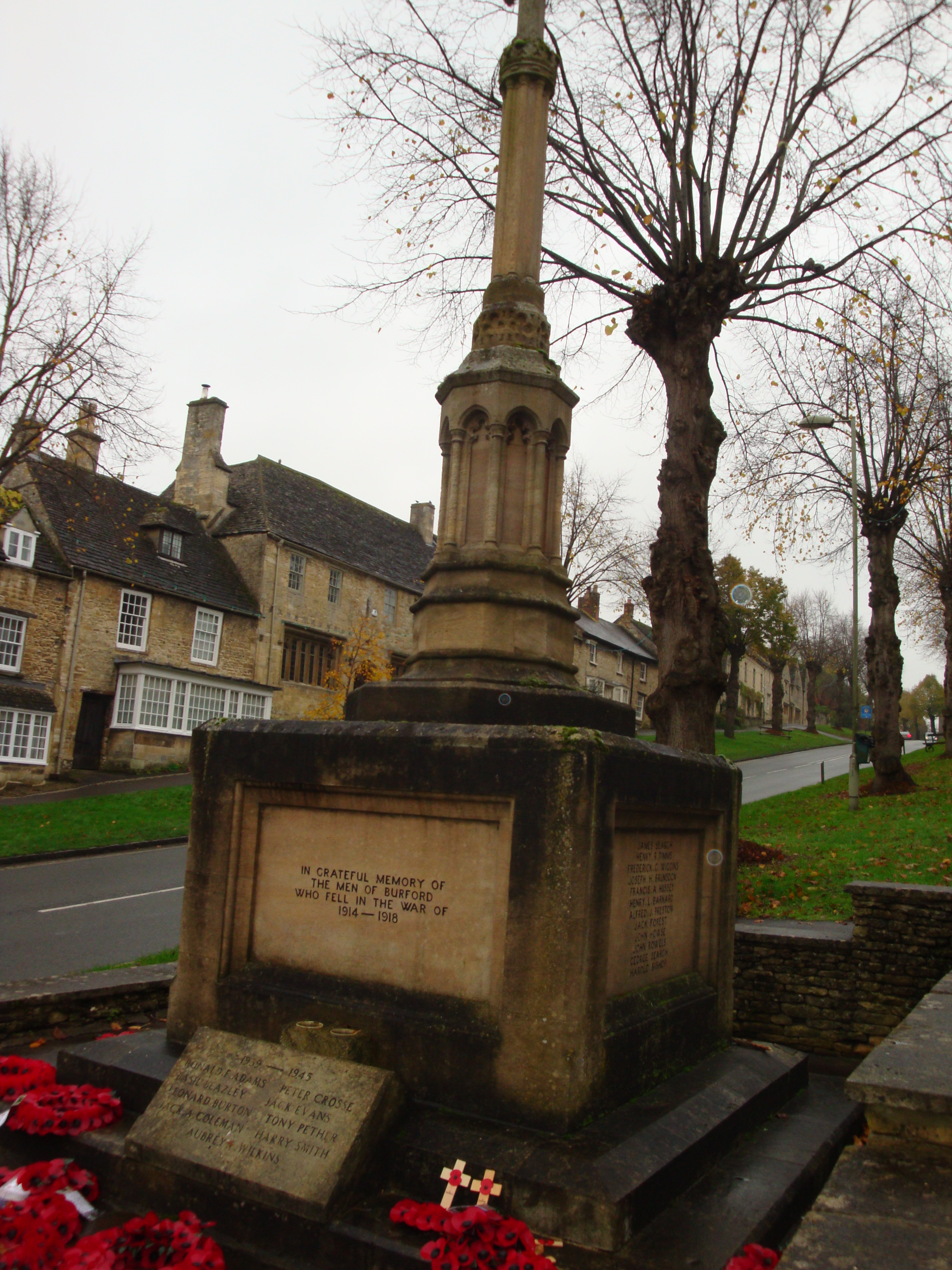
On the high street of the town near our village stands a simple war memorial engraved with the words “LEST WE FORGET”. Shoppers walk by, cars zoom past and life seems to go on all the time as normal – and yet – there are always poppy wreaths laid at its base. Come rain or shine, it seems that in our town it is always Remembrance Day. I don’t know who lays the flowers there, but there they always are. It seems that the war is still remembered here, and in so many other towns and villages of this small, island nation which sacrificed so much so long ago.
The scarlet poppies that covered Flanders and Northern France after the war only grow in ground which has been disturbed. By the end of the war they were just about the only thing which would grow on the barren battlefields where so many had fought and died. Poppies became a symbol of remembrance of those who died in past wars.
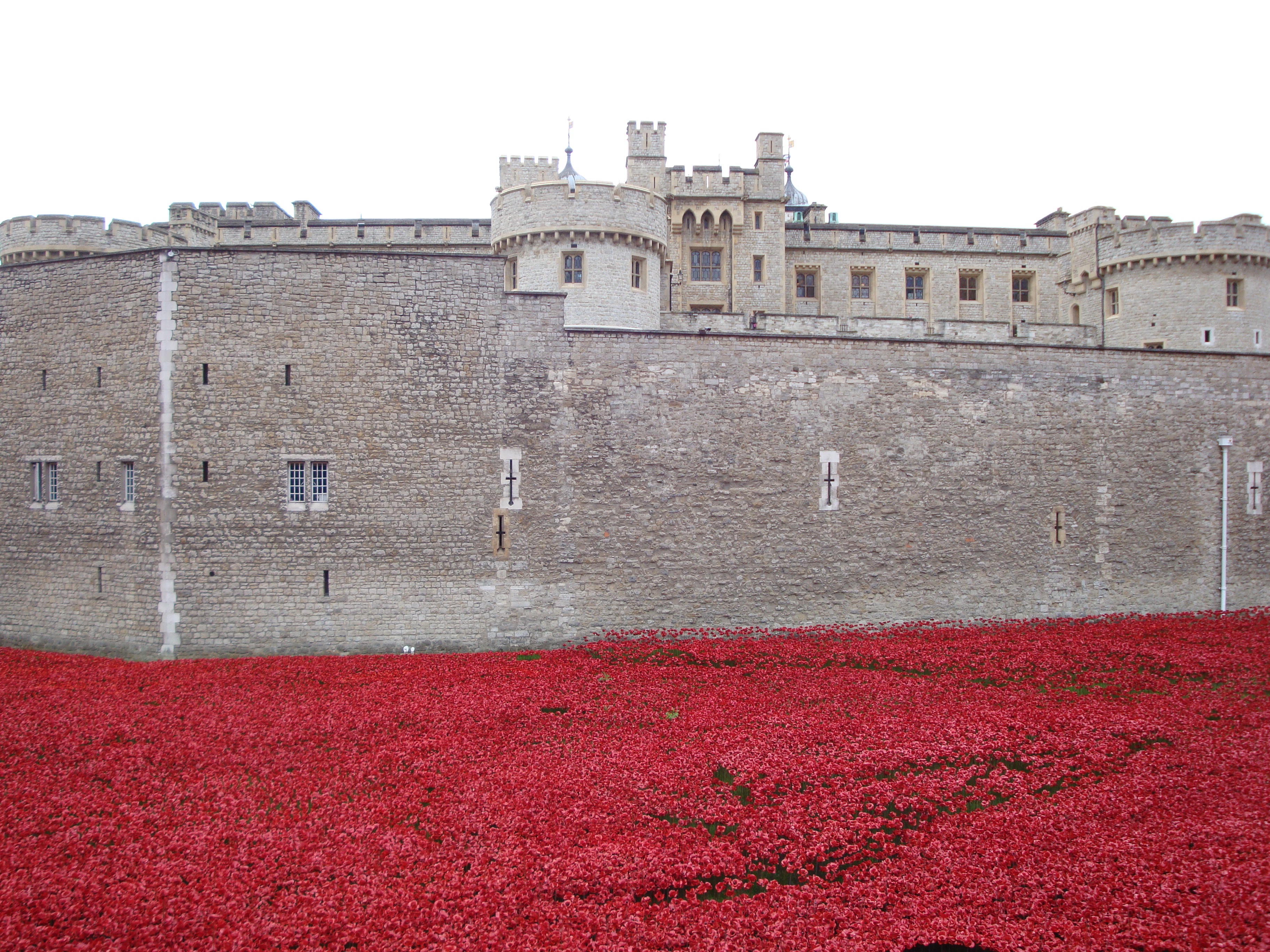
To commemorate the 100 year anniversary of the beginning of WWI the Tower of London created an exhibit titled: “Blood Swept Lands and Seas of Red”. Throughout the summer the moat surrounding the iconic Tower of London was gradually filled with an installation of 888,246 ceramic red poppies, each flower representing a British fatality in WWI. It was a dramatic and moving display viewed by millions in person, in news reports, and online. It was a reminder of a nation which has not forgotten the losses of 100 years ago, a nation that remembers those who paid such a dear price.
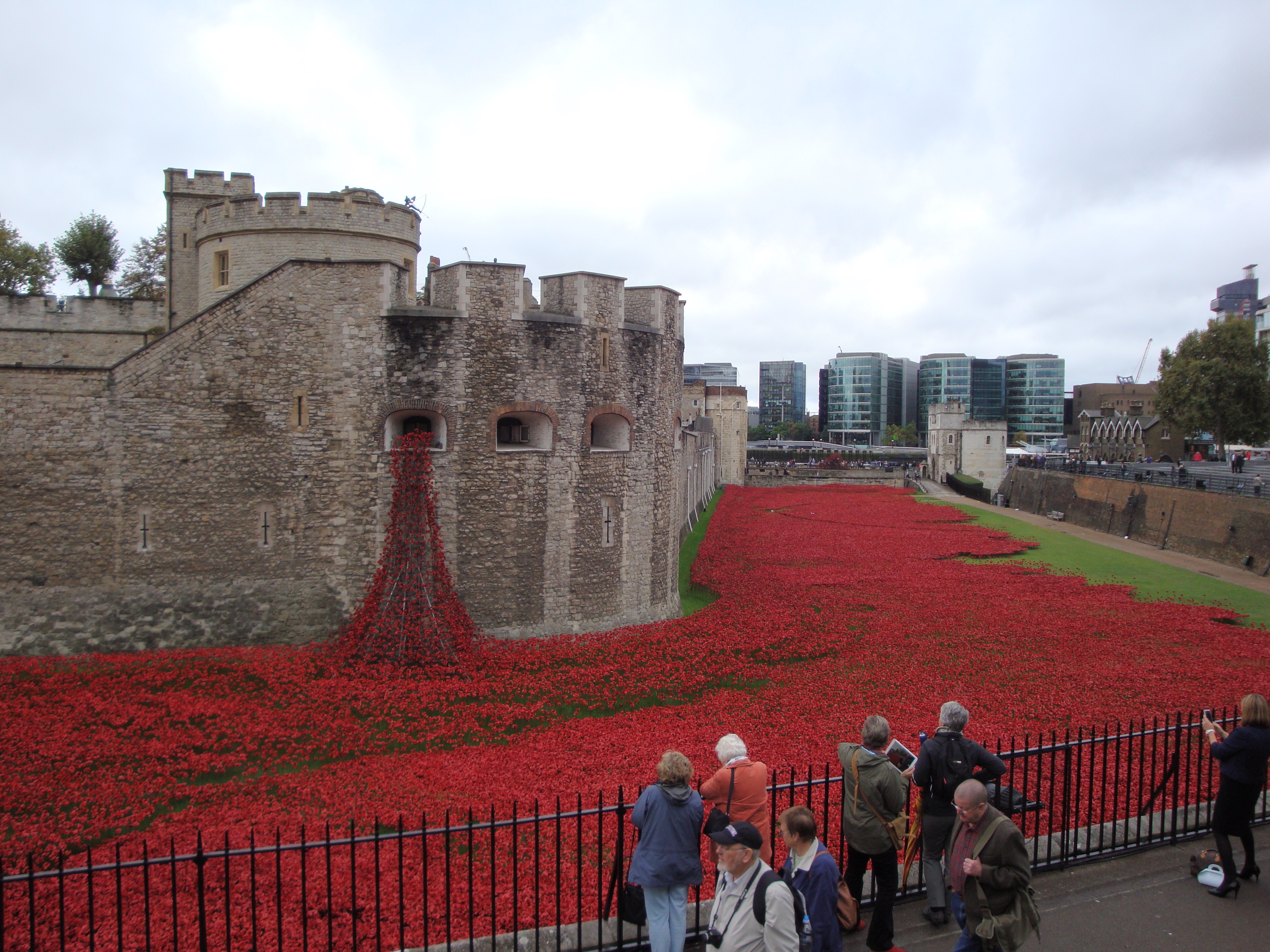
I visited the Tower exhibit with my niece in October. It was sobering to look out at that incredible display, to realize it was not yet completed, and to know that each of those flowers represented a human life.
I couldn’t help but think back to a mild day last May. It was bank holiday weekend and my husband and I drove up to the Cotswolds to the village of Bourton-on-the-Water. The village was swarming with coach-loads of tourists picnicking on the grass, wading in the river, licking ice cream cones as they spilled out over the pavements and into the roads. It was noisy, chaotic and crowded.
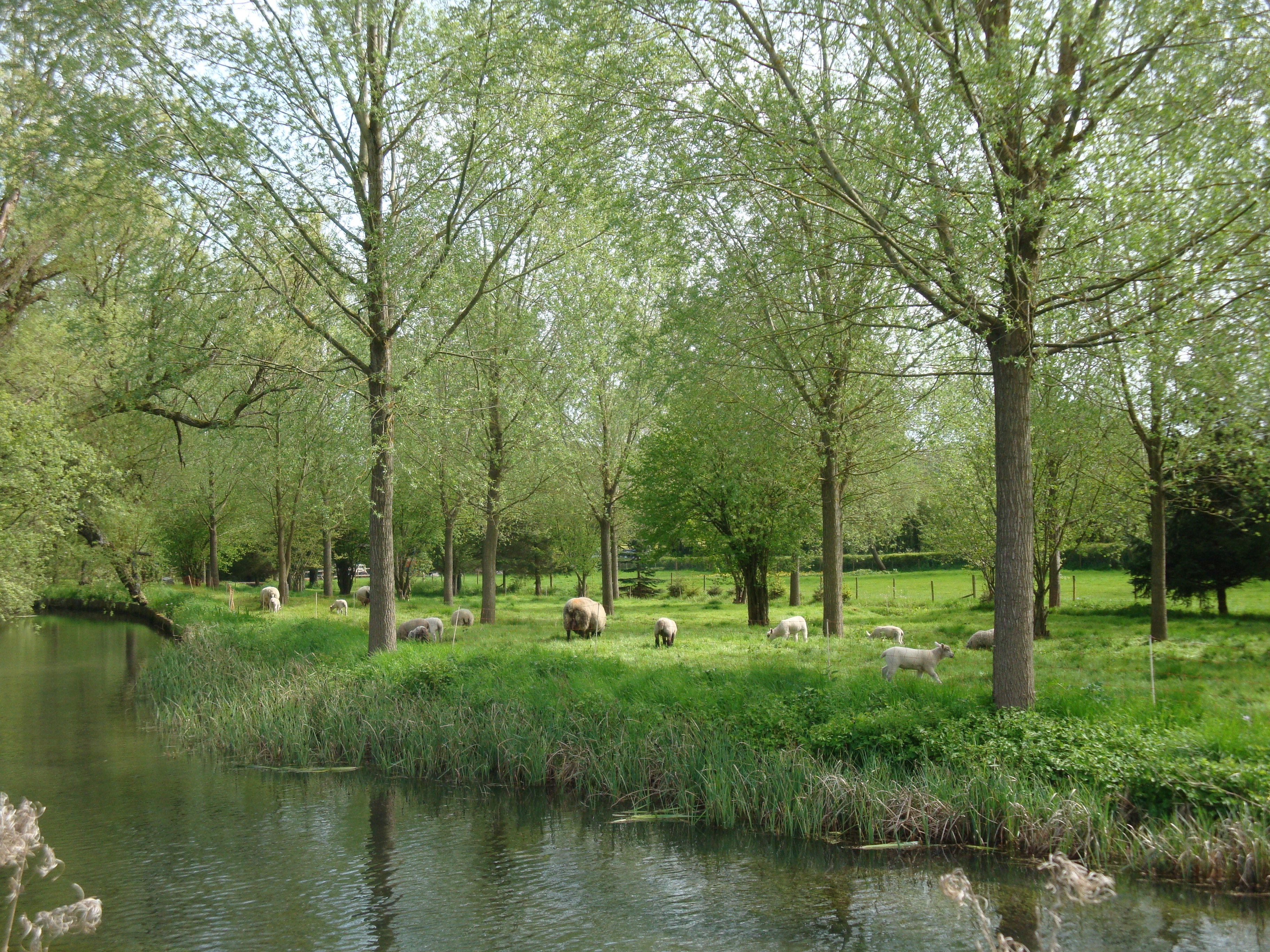
After looking around the village we struck out cross country, following the footpath on a gentle walk to the neighbouring villages of Lower Slaughter and Upper Slaughter. In spite of their gruesome-sounding names, “slaughter” is merely derived from an old English word meaning “muddy”. The sounds of the crowds and the fumes of the motor coaches quickly receded, to be replaced with the gentle ripple of water in the River Eye, the singing of birds and the bleating of sheep. Soon sheep outnumbered people, and those few people we did pass were walking sedately, no longer rushing headlong toward the ice cream stand or trying to disentangle squabbling dogs. We were walking purely for the joy of being out in the fresh air, with no fixed agenda or timetable.
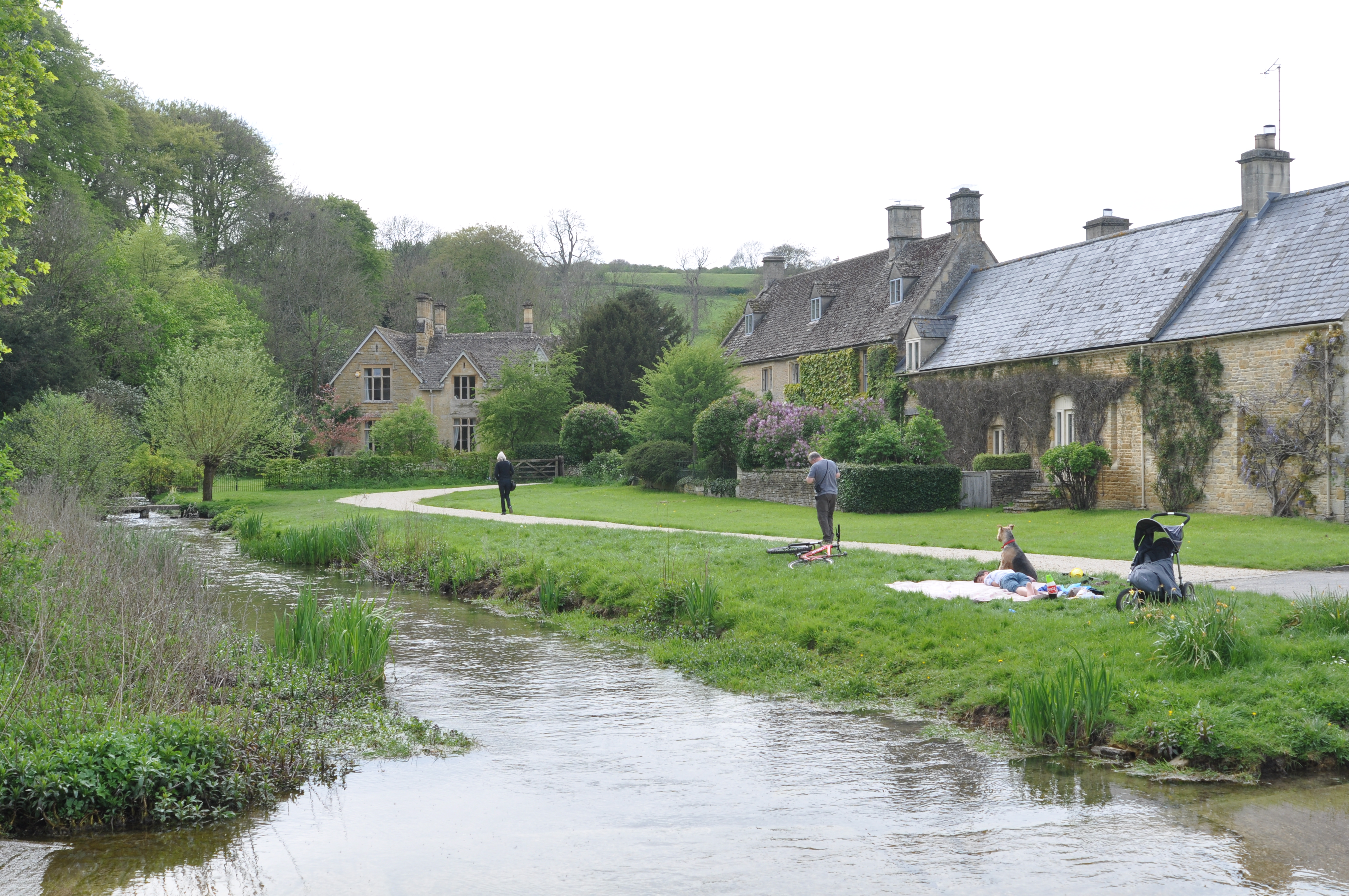
Upper Slaughter was the last village we came to before turning around to retrace our steps, and it was the quietest and the most remote. There were few people about – just a couple strolling slowly down the road and a few picnickers stretched out on blankets beside the river, dozing in the warm sunshine. It was the sort of place that it seemed time had forgotten, even down to the old, 1920’s era car parked in front of one of the houses.
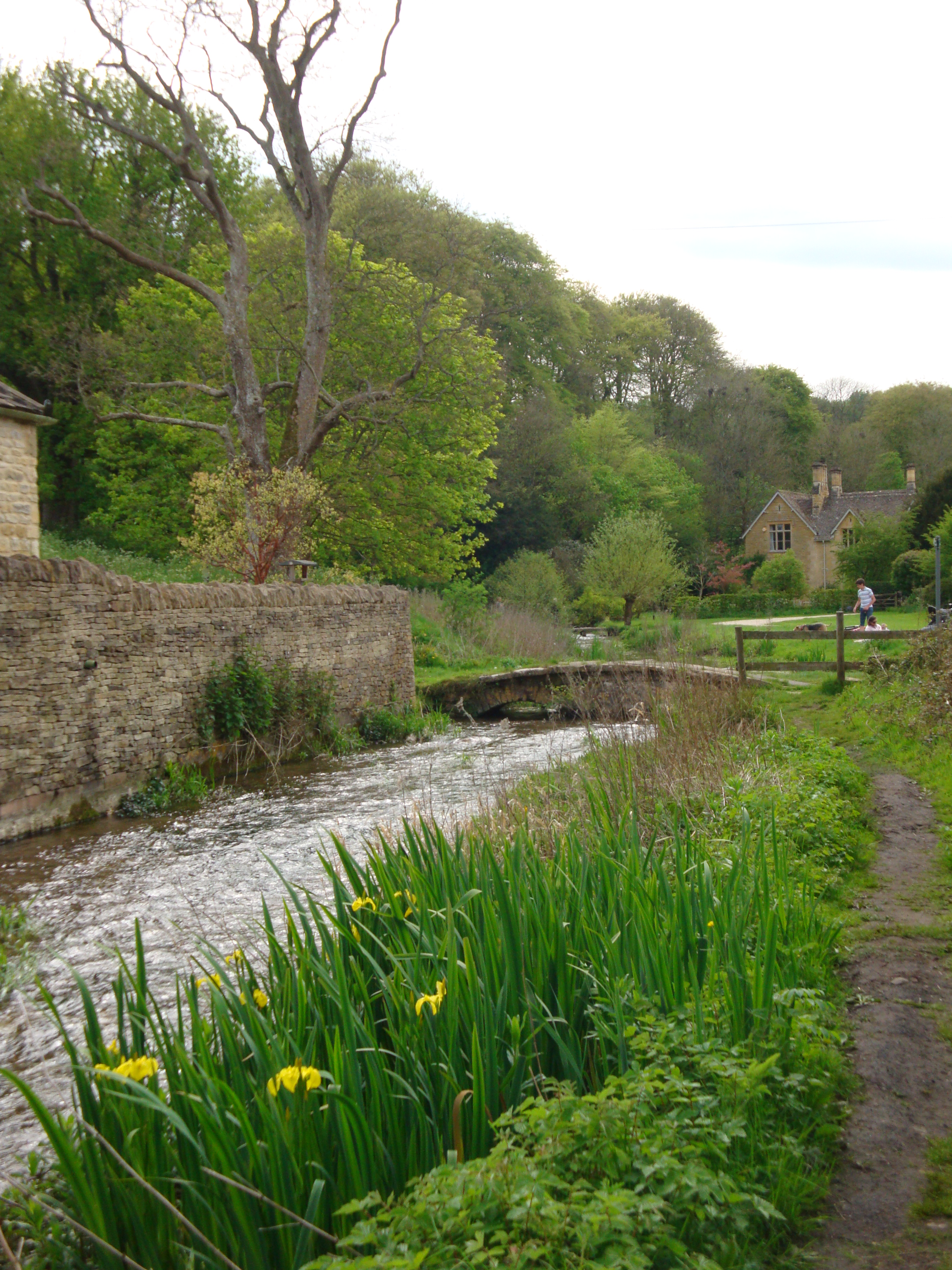
It was here that I first learned about the Thankful Villages, for Upper Slaughter is one of just 13 “Doubly Thankful Villages” which saw all of their soldiers who went away to fight in WWI and WWII come back home alive. Is that what contributes to the feeling of gentle peace and tranquillity of that area? There is no war memorial in the centre of the village where wreaths of poppies are laid as a reminder of those lost.
And so as I stared out at the incredibly moving display of poppies at the Tower of London my thoughts strayed back to that day in May when I stood in a thankful village. I couldn’t help but wish that all villages and towns could be thankful for the same reason. I couldn’t help but dream of a world in which each of those ceramic poppies represented a life lived to its fullest potential rather than cut short by the violence of war, where poppies grow in fields disturbed only by ploughs, not mortar shells and artillery.
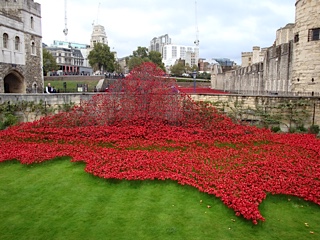
Thank you to Beth for allowing me to use her photos of the Tower of London Poppies

 An American Wife in Wiltshire
Thank you so much for this moving post. I did not know about the Pals Brigade or the Thankful Villages, but I am going to study those now. Your dream is one I share.
I really love your writing. It brought on goosebumps just reading it.
Thank you, Pete.