

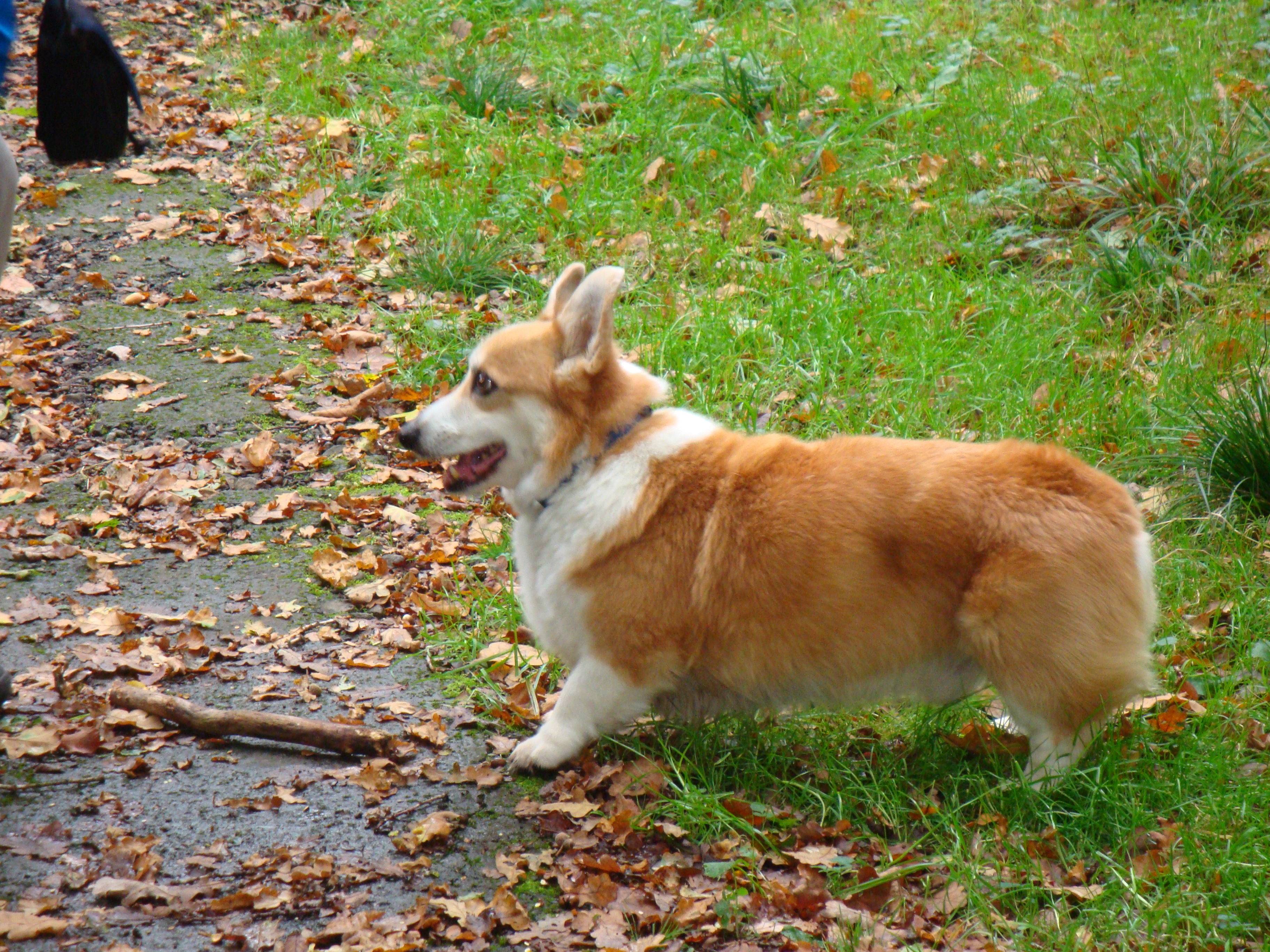
“If you eliminate smoking and gambling, you will be amazed to find that almost all an Englishman’s pleasures can be, and mostly are, shared by his dog.” ~ George Bernard Shaw
From time to time my friends and acquaintances have emailed me to ask questions about some of the differences I have found between life in the UK and life in the US. Since much of my blog-writing time is often spent dithering around trying to choose a topic to write about, I’ve decided to make life easier this time and address one of those questions, one which is near and dear to my heart.
Are there any differences in how pets are treated, and what species are treated as pets?
Now, I could start off by quoting a bunch of dry, boring statistics, but I won’t. Instead, I shall recount what I have noticed in the past year and a half of living in my little village in Wiltshire. Although highly unscientific – this little controlled study of one – I shall nevertheless use my observations to extrapolate a general idea of the life of pets here in the UK.
And yes, I have to confess that the above statement was shamelessly constructed for the sole purpose of allowing me to use the word “extrapolate” in a sentence for the first time in my life.
So, what goes on in the world of pets here in Southwest England?
Cats laze about on sunny window sills looking superior; dogs drag their owners out on walks in the roughest of weather looking delighted; budgies chatter in their cages and try to look wise, but don’t quite manage it; tortoises wander around in circles looking wise and tortoisey; horses stand in their pastures looking bored; fish swim in and out of the artificial reefs in their tanks looking lost and absent-minded – you’d be hard pressed to tell the difference from one side of the Atlantic to the other.
Animal lovers the world over are very much the same. People give their cats silly names like Mrs. Farnsworth and watch an average of 1.2 hours of silly cat videos on YouTube every day. A large percentage of people (she said, quoting no statistics whatsoever to back up her claim) acquire a second pet for the sole purpose of being company for pet #1. And here’s a genuine statistic for you, culled from a quick internet search: 95% of pet owners celebrate their pet’s birthday. Both here in the UK and back home in the US pets in general have a good life. There are some sad exceptions, of course, but thankfully all of the pets I have encountered have been much loved and well cared for.
One of the things I noticed when I first arrived in the UK and began walking my dog around the neighbourhood was the abundance of tails. Everywhere I looked were dogs with long tails – curly tails, thick tails, tiny whip tails and feathery tails. Since 2007 tail docking has been banned in England, Scotland and Wales, except for a few exceptions for working dogs or for medical reasons. Tail docking is still allowed in the US in order for dogs to conform to the breed standard set down by the kennel clubs. In the UK the breed standards have been revised to reflect that show dogs will now have the tails they were born with.
My Tristan is a corgi, and given his age his tail would have been docked even if he had been born over on this side of the pond. In the US it’s quite easy to tell someone who asks what the difference is between a Pembroke Welsh Corgi and a Cardigan Welsh Corgi. In the US we just say, “The Pembroke is the one without the tail.”
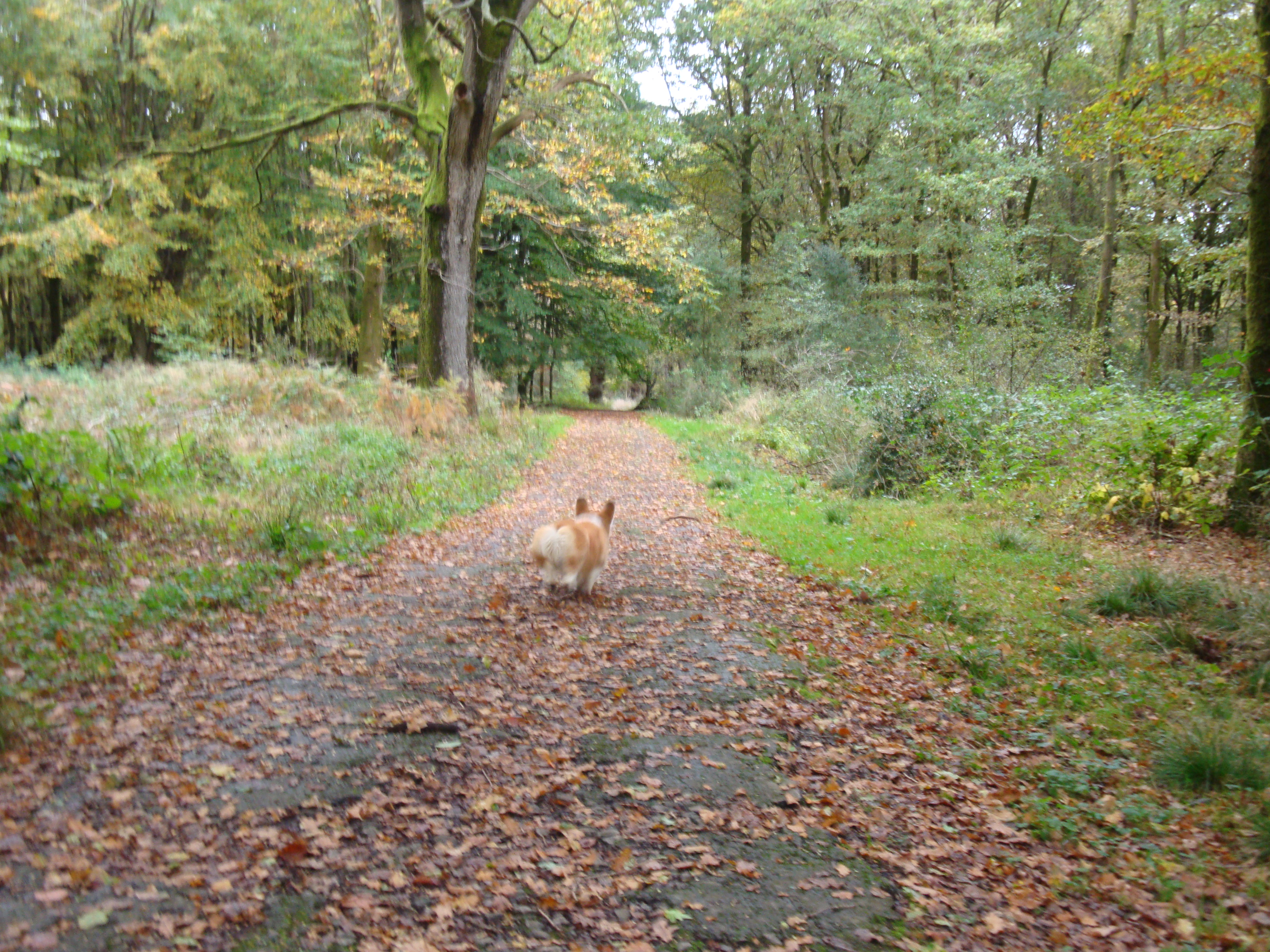
The other day I was walking Tristan and a fellow dog walker stopped to ask me which kind he was, and how you can tell them apart. I had to resort to saying the Pembroke has a more refined, foxy face and slightly smaller ears and body, but by then his Labrador and terrier had both managed to wind their leashes around his legs and exchange some rude words with Tristan, so we quickly parted company.
It is thought by some that the fact that their tails are no longer docked is partially to blame for the corgi’s decline in popularity in this country. No one who has ever walked behind a corgi with a docked tail can deny that there is something incredibly humorous in watching that little backside swing back and forth. They look like a cross between a bunny rabbit and a dog with their short, stubby legs and the white fluff where their tails would have been. A corgi’s tail is actually quite a magnificent appendage, being as thick and full as a fox’s brush, but it is definitely not an object of mirth. And so corgis here in the land we consider to be the bastion of Corgidom – given their perpetual popularity with the queen – are actually quite rare, and their numbers are dwindling; a sad fact considering what devoted and fun-loving companions they can be.
One of my favourite dog breeds, the breed we had as children growing up, is the cocker spaniel, and I have to say that a cocker spaniel with a tail is a thing of beauty. A neighbour of mine often exercises her dogs down in the big field at the end of our street. Her cocker spaniel is that enviable of all dogs, a Frisbee catcher. She throws the Frisbee, and her cocker takes off after it. The dog is the colour of dark amber, her coat shiny with good health, and she flies across the field with her long, feathered tail waving like a flag behind her. Anyone who has ever owned a cocker knows that their tails wag almost continually, so it seems only right that they should have such a beautiful tail to wag.
So, it’s the UK-1, US-0 in the matter of tail vs no tail.
Another fact I encountered when moving here with doggie in tow is that from the 6th of April, 2016, all dogs will have to be micro-chipped and registered by the time they are eight weeks old. In the US micro-chipping is recommended, but as far as I know there are no laws requiring it. Speaking for myself, my dog has always been micro-chipped, and it has always given me great peace of mind to know that if he were ever lost he could easily be returned to me.
By my reckoning that makes it UK-2, US-0, though some people might argue that there is such a thing as over-regulation, and that people should have the right to decide for themselves whether to micro-chip their pets or not. So we’ll call that one a draw, shall we?
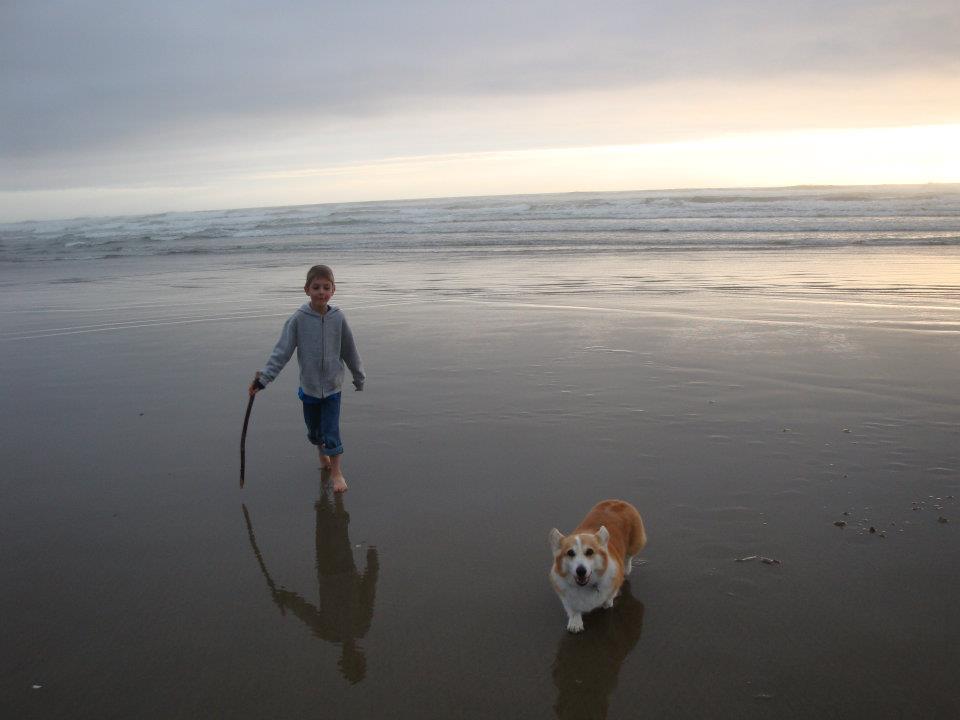
Another key factor I shall use in judging between the two countries is a very important one to me, and that is beach access. Anyone who has ever experienced the unmitigated delight and exuberance of a dog on the beach knows that to be barred from that joy is a sad thing indeed. Many beaches in the US do not allow dogs, and some only allow them in the off season or during certain hours of the day. This is largely the result of lazy dog owners who do not clean up after their pets. That being said, I have to commend the state nearest and dearest to my heart, Oregon, for allowing dogs on its beaches. Within the confines of a state park, or in the vicinity of ground-nesting birds, dogs have to be on leads less than 6 feet long, but the rest of the time they are allowed to romp and play with wild abandon – as long as you keep them under your control.
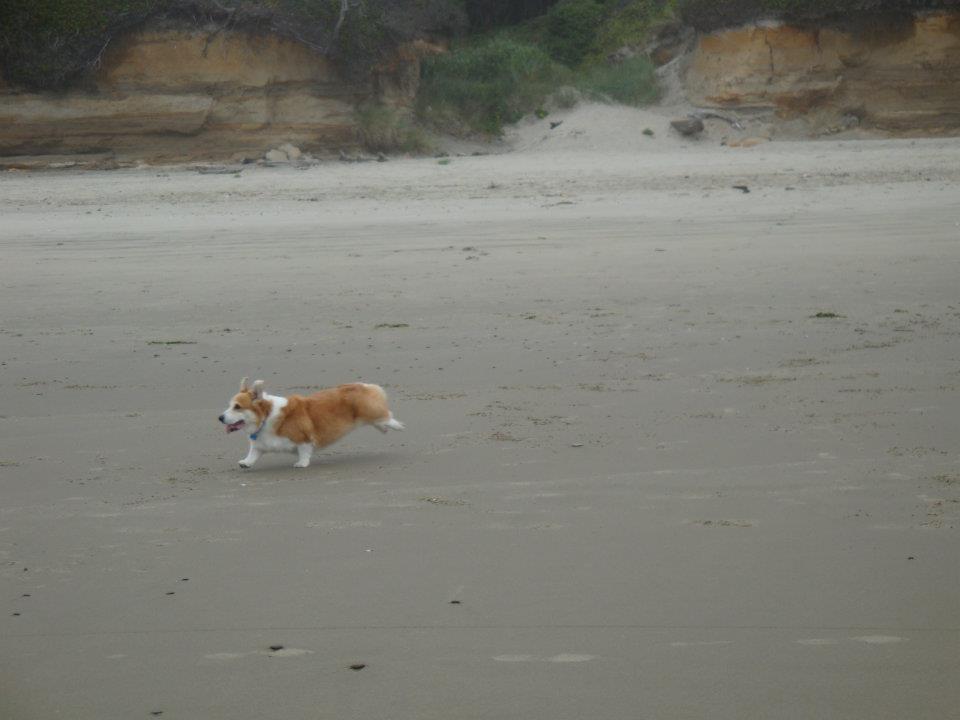
For years I have enjoyed taking my dog to the beaches of Oregon, and each time his toes hit the sand he radiates happiness, running and barking and having a wild old time. He will run until he has used up every last ounce of energy, then flop down into deep, exhausted sleep, so that we can scoot him along the floor from one room to the next without disturbing him; but then if someone heads out the door to go to the beach again he jumps up and is ready to go once more.
Dogs and beaches just go together like apple pie and vanilla ice cream.
What are the rules governing dogs on beaches here in the UK? Varied. Each beach seems to have its own rules. Some allow dogs to run free as long as they are under control, others only allow dogs during certain months of the year, others only allow dogs if they are on leads, and some don’t allow dogs at all.
So when it comes to that all-important criterion of beach access, it is once again a draw, with similar regional variances coming into play in both countries.
This brings me down to the tie-breaker: general access to public places. On this one I have to declare the UK the winner from the very outset, at least from my own experience.
The Pacific Northwest of the US, which consists of the states of Washington, Idaho and Oregon, is one of the most dog-friendly regions of the country. Many businesses will provide basins of water near their doors for thirsty dogs to drink from, and many restaurants with outdoor dining terraces will allow your well-behaved canine companion to join you if you eat outside. However, never in the US have I ever been able to take my dog into the sorts of places where I see dogs here in the UK in general, and in Wiltshire in particular.


Since moving to the UK I have found that many pubs will allow dogs in the bar, though not the restaurant. Since food is served in both the bar and the restaurant areas we have been quite happy to sit in the pub with Tristan at our feet and enjoy the warmth of an open fire and a light meal after one of our long walks.
Tristan is enamored with this new pastime and has developed quite a winning technique. He will settle himself down near us and gaze intently at our fellow patrons, his head cocked a little to the side as if he finds them somewhat puzzling. With his big ears and his sweet face it is not long before he begins to draw a crowd of admirers.
At the last place we visited it went something like this:
Two grizzled elderly men at the next table over began talking about him. “A corgi. You don’t see many of them these days.”
One of them got up and came over to meet Tristan, and by default us, his humble owners. “You know,” he said, “it’s funny, just this morning I read an article about corgis, and then I was doing the crossword and one of the clues was a corgi, and now here you walk in this afternoon with a corgi.”
This, we all agreed, was quite remarkable, and must certainly be a sign of something.
His friend piped up. “The queen has corgis. Ha-ha! You’re not her, are you?”
How I, a tall, forty-something American woman in muddy jeans and a ratty old coat, could be mistaken for the queen, a rather small, eighty-something English woman in matching shoes, hat and handbag is beyond me, but it was his attempt at humour, so we all shared a bit of a laugh, and his friend saved the day by saying,
“Don’t be daft. She’s much prettier than the queen. Ha-ha!”
At that point the young waiter brought a tray over with my pot of coffee (ah, bliss!) and said, “Can I just say that you have the cutest dog, ever.”
Why yes, you can say that.
Then the first man asked what his name was.
“Tristan,” I answered.
“Trischeon?” He asked doubtfully.
“TrisTAN.”
“Oh.” He thought for a moment. “Do you have a nickname for him?” Clearly Tristan was considered to be one of the stupidest dog names of all time.
“Tris,” I meekly said, at which I received a look which told me I was obviously a person of no sense whatsoever. I feebly attempted to explain that I had named him after the character on All Creatures Great and Small, Tristan Farnon, but it was too late. I had been consigned to the realm of stupid dog owners because my dog was not named Bob, or Skip or something sensible. Perhaps if I had said his nickname was Stinky Tris I would have redeemed myself, but it was too late. The damage was done.
Next, a woman from two tables away got up and came quietly over and presented Tristan with a sliver of the roast beef from her dinner. He put on his best possible company manners and took it with incredible politeness from her fingers, then gazed soulfully up into her face. I had a feeling he was pledging to go home with her if she’d give him roast beef every day.
It was delightfully warm and convivial, and had a sweet, old-fashioned feel to it. We came away from there with warm memories, vowing to return once again, and it was all because we had a dog with us. If it had just been my husband and I sitting quietly at our table no one would have engaged us in conversation. We would have remained on the outside, strangers in a strange land. Having a dog with us opened the door to meeting people, and made me realize what an ice breaker an animal can be.
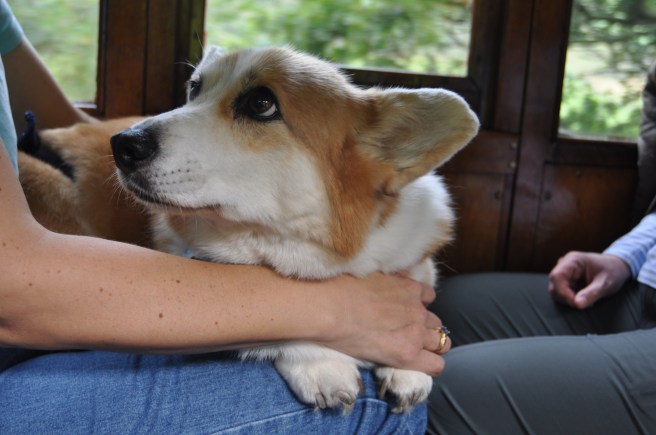
And so I have found that I am more likely to interact with people when I have my dog with me than when I am alone. People on the bus will talk to him and smile and fellow dog walkers will stop and chat. Having a dog helps remove the barriers that hold people aloof, and you find yourself talking to complete strangers – people who otherwise would have passed you by staring off into the middle distance somewhere over your left shoulder. And so I have to say that I am grateful to be able to take my little dog with me into the café in town, into the gift shop or on the train. It makes the world immediately seem a friendlier place.
As I write this, sitting at the desk in the corner of our conservatory, I have only to turn my head and glance down to see my ever faithful Tristan curled up asleep on his blanket beside me. He snores softly, and occasionally his paws twitch, but if I pause long enough in my typing and sit gazing down at him he opens his eyes and looks up at me, and when he does my heart melts. To some people Tristan may be “just a dog”, but to me he has been a faithful companion for over ten years now.
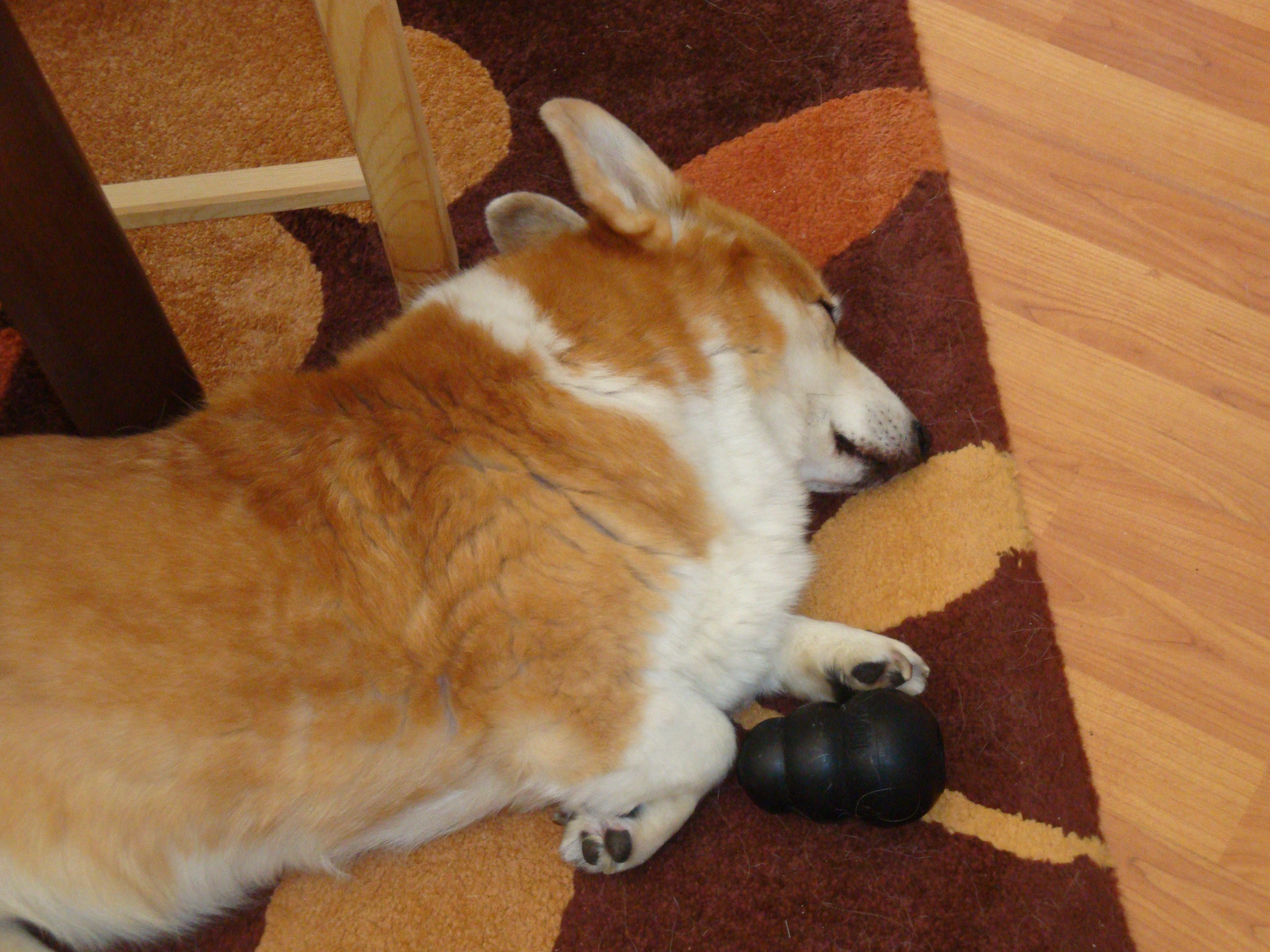
What, I wonder, would the past eighteen months have been like without his gentle, patient company? There have been days when all the changes overwhelmed me, when I felt homesick, when I missed my family, when the feeling of being an outsider seemed too much to bear; and on those days I always had Tristan. When all you want to do is sit on the floor and cry there’s nothing quite so soothing as the gentle nudge of a little black nose, the melting gaze of two luminous dark eyes, and the warmth of 30 pounds of corgi crawling into your lap to make you feel that you can go on, and that the joys of this new life you are living will once again chase away the sorrows of what you had to leave behind.
In the end I have to conclude that pets, no matter where they are, provide something we all need: companionship, love, solace, occasional silliness and undying loyalty. We who experience the rewards of pet ownership can be forever grateful for these gifts given so freely, and in return we strive to give our pets the best lives we can during their fleeting time with us.
“Let Hercules himself do what he may,
The cat will mew and dog will have his day.”
~ William Shakespeare

 An American Wife in Wiltshire
Of course you have the cutest dog!
This is true. He is absolutely adorable.
What a wonderful read! Tristan is a doll!
…and I LOVE his name! 🙂
Thank you, Georgina. Yes, Tristan is a doll. And since his name was originally Virgil I think Tristan is definitely an improvement. Can you imagine what those men would have said if I’d told them his name was Virgil?
Oh, wow. Yes, Tristan is quite the improvement! And one can only imagine what those men would have said. I can picture their looks of horror…lol. I believe a quick departure would have been in order.
Yes, I would have never been able to show my face in that pub again.
Those photos of him flying across the sand are so lovely! What a sweet doggie. Love the train photos, too.
Yes, he is a sweetie, and never happier than when racing on the sand. Right now he’s sending wide-eyed love looks at “Daddy”, who is eating a sardine sandwich.