

It was the best of teas; it was the creamiest of teas…
In America, when we think of tea in the sense of it being a meal rather than just a beverage, what we think of is the elegant repast known as afternoon tea. Images of the grand afternoon tea at the Empress Hotel in Victoria, BC spring to mind. We think of liveried waiters winding through a sea of chin tz fabric and polished wood, bearing aloft silver serving trays laden with delectable pastries, exquisite miniature sandwiches and pots of steaming hot tea. That, for us, is tea. And so it is slightly baffling when we first arrive in this country to see signs hanging outside tea shops in nearly every village and town advertising something mysteriously called a cream tea.
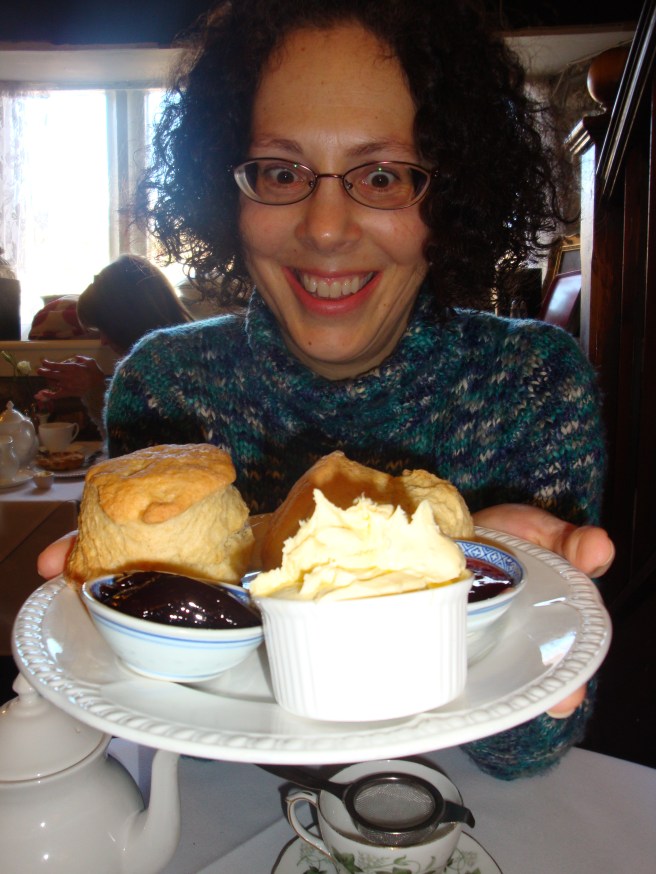
What, exactly, is a cream tea? We know that most British people take milk in their tea, something that is still not as common in America. Is that what they mean by a cream tea? Does it just mean tea with some cream in it instead of plain milk? Is it the tea version of that naughty but delicious American invention, the Caffe Breve? No, it is not. A cream tea, sometimes also called a Devonshire cream tea, refers to a cup, or a pot of tea served with scones, cream and jam. As simple as that.
Or is it?
Last summer I was sharing a casual cup of tea and conversation with friends at the end of a long, busy day, when the subject of scones came up; specifically, how scones ought to be eaten. It turns out there is some disagreement on the subject, and people take sides along distinct geographical lines. On one side there is the Devonshire method – spreading the warm scone with thick cream, followed by a layer of jam. On the opposite side, adherents to the Cornish practice believe that the jam should come first, then the cream.
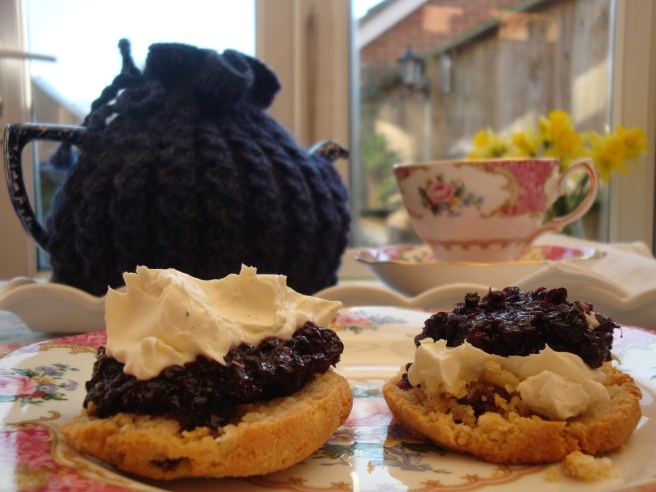
“Well, obviously the jam goes first,” I declared. It had never occurred to me to put the cream first. What a silly thing to do. A big dollop of whipped cream obviously goes on top of a warm, jammy scone.My mother and I have eaten our scones that way for years. After all, if you put the jam on the top of the cream you’re likely to end up dribbling jam down the front of your shirt.
At this opportune moment Mr. H appeared. Happy, relaxed, at peace with the world, all he wanted was to sit down and enjoy a cup of tea; little did he know the hotbed of controversy he had stumbled into. Clueless, he cradled his warm mug of tea in his hands and beamed all around. I wasted no time drawing him into the discussion.
“Which do you think should come first on a scone – the cream or the jam?” I asked, confident he would agree with me.
“The cream, of course.”
How is it possible I had been married to this man for over two years and never paid attention to the fact that he puts the cream on his scone first? So much for my powers of observation.
Our small group continued the good-natured but heated debate. We had reached an impasse when another hapless husband appeared and was enjoined to settle the matter. Do you spread the cream first on a scone, or the jam? He regarded us all with a twinkle in his eye, and I think before he even opened his mouth his wife knew there was mischief afoot.
“You take the two halves of the scone,” he said in his lovely Scottish brogue, holding his hands up and miming holding half a scone in each, “and you put cream on one half, and jam on the other half, and then you smoosh them together.” He smooshed his make-believe scone together, and that was the end of that.
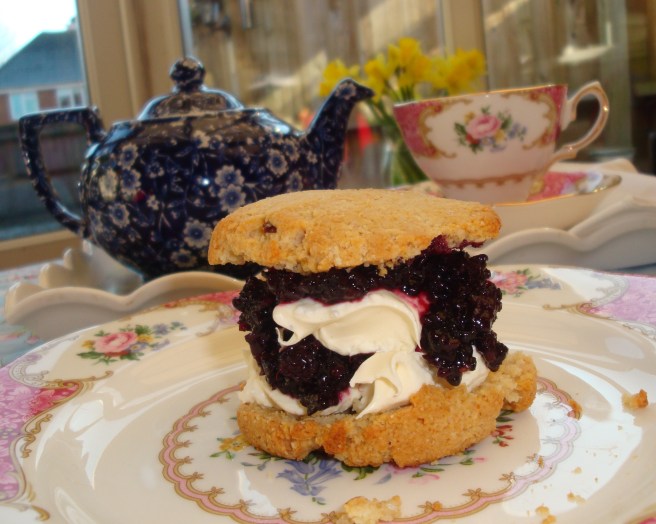
- The unofficial Scottish smoosh
Curious, I posted a query on Facebook, a not-so scientific method for fact finding, but a fun exercise in opinion gathering from my friends on both sides of the Atlantic. What I learned is that much depends not only on where someone grew up, but also on how thick the cream is that is being used. And that brings us to the crux of this whole issue, one dear to my heart: cream.
In America we have all the same types of milk available as here in Britain. On grocery store shelves in both countries you will find skim, 1%, semi-skim and whole milk. It isn’t until we enter the epicurean realm of cream that Britain far outstrips America in the range of available options. Here is a brief run-down of the various types of cream products available, listed by the percentage of milk fat.
-
12% – American half and half. British people are often confused by the notion of half and half. Basically, it is milk and cream combined. It doesn’t whip, but is used as a creamer in coffee or tea, and also for soups and gravies as a lower-fat alternative to cream. Many people think this is still too much fat, so they buy something called “fat-free half and half”, a frightening concoction of skim milk, thickeners and chemical additives meant to mock the taste of the real thing.
-
20% – American light cream or British single cream. This doesn’t whip very well, either, and it is usually poured over desserts like fruit crumbles.
-
30% – American whipping cream. This whips, but does not hold up very well and is rather wimpy.
-
36 – 38% – American heavy whipping cream – the real stuff. This doubles in size when whipped and holds its shape well.
-
48% – British double cream. Very rich, whips in seconds, delicious and thick.
-
55 – 60% – Devonshire clotted cream. Here we enter the dimension of the sublime. Unbelievably thick, with a faint, nutty sweetness, this is what is traditionally served with tea and scones. Its texture and density is probably somewhere between whipped cream and butter.
Why is it necessary for me to point out all these variations on a cream theme? Just take a look at where the American cream stops, at 36 – 38% fat, and note how much farther the Brits take it. Here in Britain we do cream like non other, and for Americans whose taste buds have been tarnished by strange concoctions like fat free half and half, experiencing real British cream is a revelation. It also explains why I’ve always put the jam first and then the cream on my scones.
Devonshire cream is a relative unknown in the US. It was when my parents moved to Australia that my mother first discovered farm fresh clotted cream at a dairy in the Yarra Valley outside of Melbourne. Two years later she returned home to the US and the search began for something similar to go on top of our scones.
Just exactly what is clotted cream? Clotted cream is made by allowing unpasteurized cow’s milk (traditionally from Jersey cows) to sit in shallow pans at room temperature for 12 – 24 hours. It is then slowly heated and left to cool for another 12 – 24 hours. The cream that rises to the surface and “clots” is skimmed off, and that is the clotted cream that you are served on your scones. Both Devon and Cornwall try to claim bragging rights for the invention of clotted cream, but all that is known for certain is that it was invented somewhere in the Southwest. Devonshire cream is clotted cream made in the county of Devon. It may not win any heart smart prizes, but it is delicious.
In all our years of searching my mother and I were never able to find anything approximating real, fresh clotted cream in our region of the Pacific Northwest. We looked in every gourmet grocery store and tea shop without success. Due to its short shelf life, fresh Devonshire cream is very difficult to export; therefore the only so-called clotted cream that we were able to find in the US was sold in jars, like Mayonnaise. It was labelled either English Luxury Clotted Cream or English Double Devon Cream. We tried it…once.  Anything which can be kept in a jar on the shelf for months is not cream. I don’t care how you label it, or if you claim that the only ingredient is cream, it isn’t the same. Something gets lost along the way, and that something is all the yummy goodness and flavor. That stuff in a jar was like spreading congealed oil and just as appetizing.
After our failed attempts at finding real clotted cream in the US, my mother and I finally settled on what tasted the best – freshly whipped heavy whipping cream. That became our scone topping of choice, and as I noted earlier, American heavy cream, with its slightly lower fat content, is quite light and airy in comparison to British clotted cream. That is why it made perfect sense for us to spread the jam on the scone first, and then crown it with a layer of fluffy cream. In America I still aver that this is the best way to eat a scone – jam first.
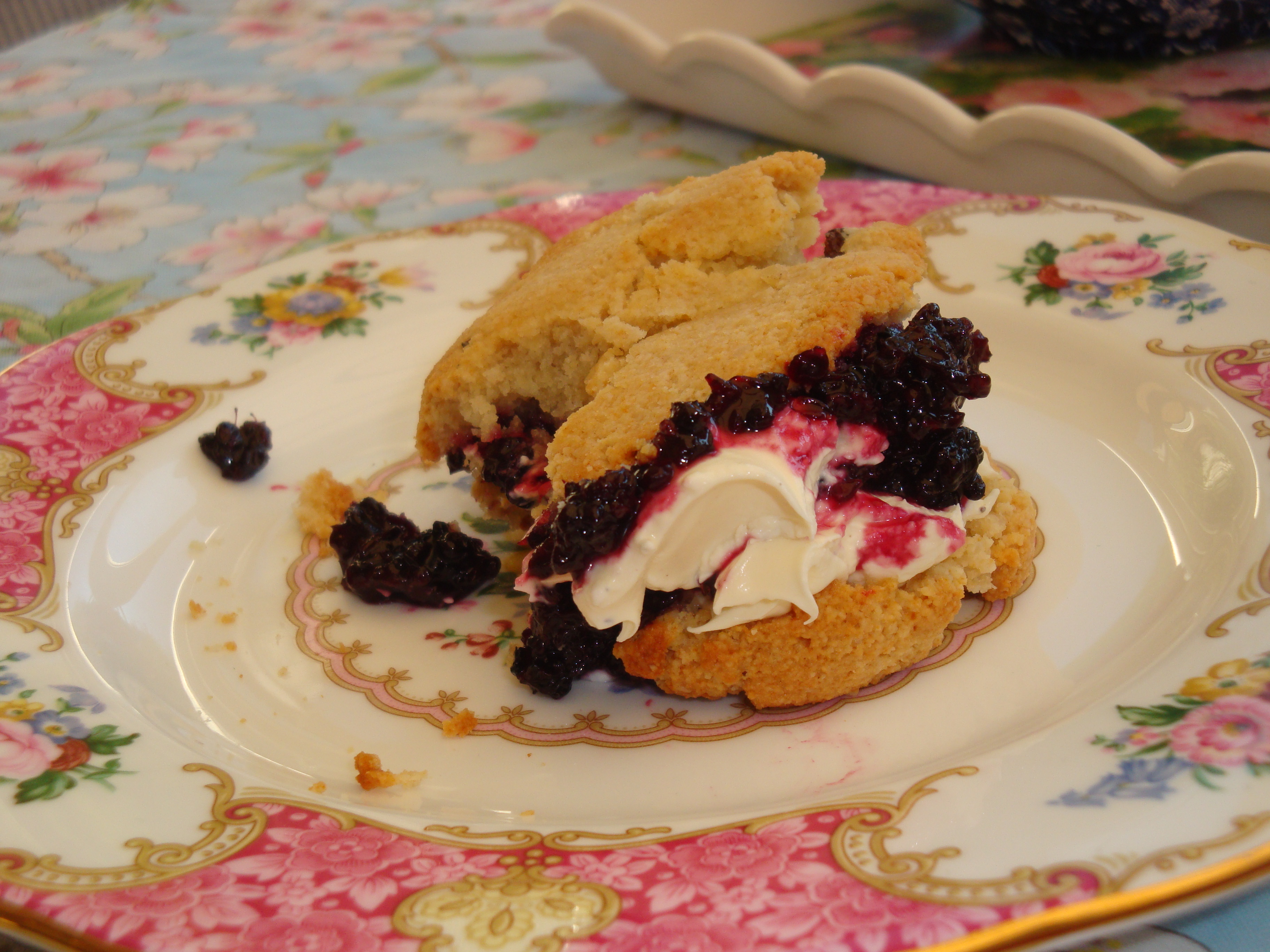
- An inherent flaw in the smoosh is its messiness.
Here in Britain, however, I have finally been won over to the Devon way. As much as I hate having to climb down from my high tower of pomposity, that is what I was forced to do after researching my way through several batches of scones. I tried, at first, to be surreptitious, hoping Mr. H wouldn’t notice that I was assembling my layers differently, but of course he did. I wish I could report that he didn’t make a big deal out of it, but I can’t. He nodded sagely, trying unsuccessfully to keep a straight face, and waggled his eyebrows significantly at me like some over-acting villain in a pantomime.
“See? I told you. It’s better that way.”
Yes, it’s true. There is more than one way to eat a scone. Whether you prefer the Devon way, the Cornish way, or even the Scottish smoosh way, they are all delicious. The French have their coffee and croissant, the Americans their coffee and doughnuts, but here in Britain we have what I think is the finest and most delicious tradition of all – the cream tea.
Stay tuned for next time when we will take a tour of some of our favourite tea rooms and invite you to share some of yours.
“If you’re afraid of butter, use cream.” ~ Julia Child

 An American Wife in Wiltshire
There is a lovely B&B which serves a fantastic cream tea just next to the Tarr Steps, Exmoor. Well worth a visit after a lovely long walk or hike. 😊
Thank you, Rebecca. We might have to go check that out once it warms up a bit. I’ve been wanting to do some exploring in Exmoor, so we’ll have to make sure we end one of our walks near that B&B.
Very informative and amusing! I’m an Australian who has never understood why some people put the cream first but now you’ve left me wondering whether I too will convert when we move to the land of clotted cream!
And I thought heavy cream was rich. Can’t wait to try the real thing cream first!
You’re going to love it!
Thank you again,Elizabeth, as usual you have gifted us with an entertaining and informative look into life in GB. I have never thought about cream as anything other than half ‘n’ half vs whipping cream (I fear the non-fat h ‘n’ h!) My American taste buds are tingling! The scones in your picture are impressive. It makes me wonder if my great grandfather learned to put his jam on top, hmm or rather yummm.
Deb Otley
It’s a shame fresh clotted cream isn’t available in the US. Perhaps more people need to come over here and try it; then the demand for it will grow. My grandmother used to make baking powder biscuits, which we’d slather with butter and jam. That is probably the American equivalent. I’ve also heard that some people actually put butter on their scones, then cream, then jam, which is definitely overkill, if you ask me.
As it happens, I have some fresh Yarra Valley clotted cream in my fridge… I use it on fresh fruit to make a delicious dessert 😉
Pure bliss!
Yes, and I bought fresh pineapple and mango for tonight! That’s if we have our power restored, tree fell on the lines 😳