

“Whoopi-ty-aye-yay
I go my way
Back in the saddle again”
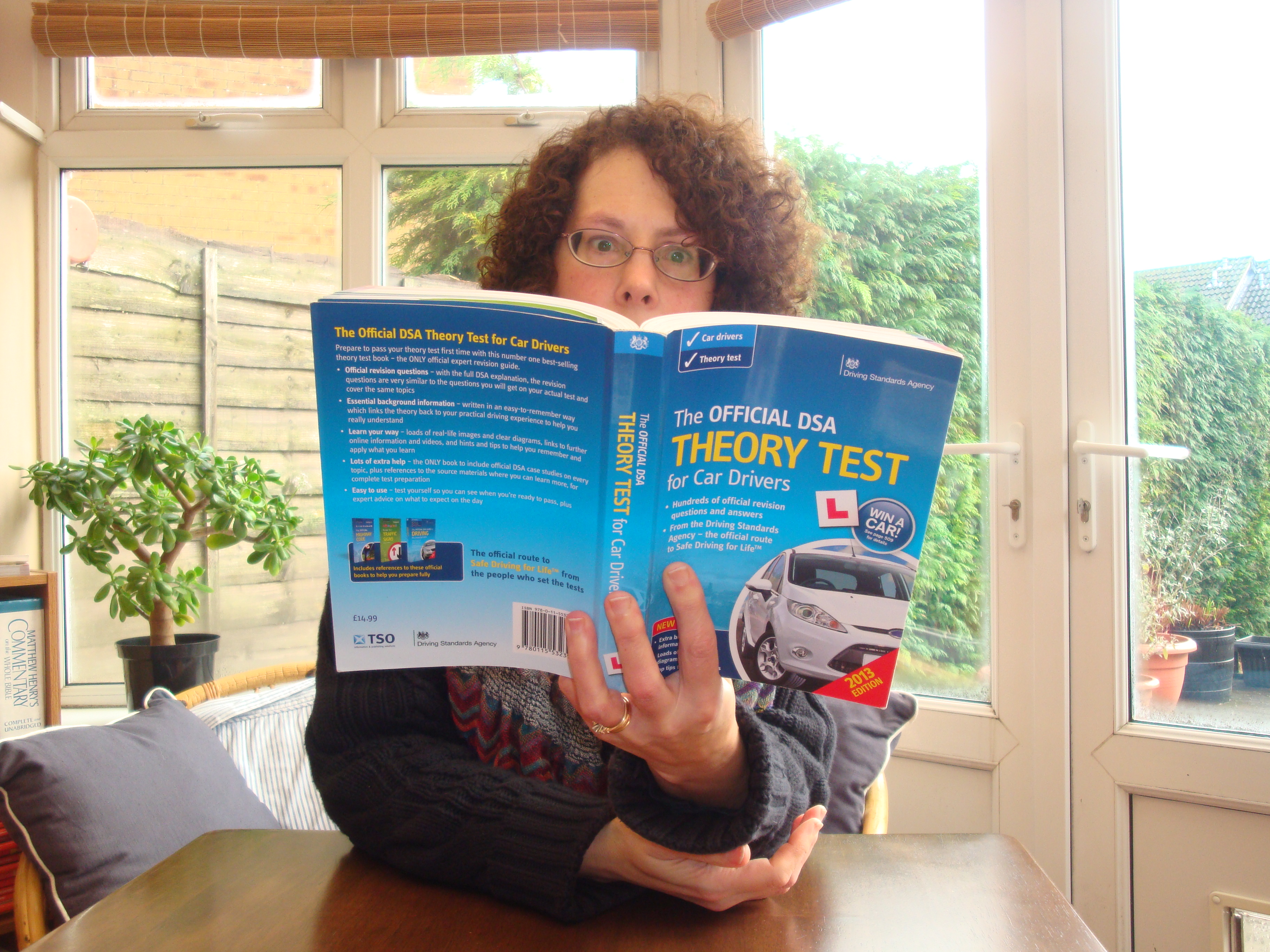 Last summer I gained some insight into the psyche of the British driver. I was standing on the main road that runs through our village waiting to catch the bus. As I watched, a large articulated lorry (a semi, for my American readers) passed the bus stop, executed a U-turn at a mini-roundabout, returned to the bus stop – only now going the opposite direction – and proceeded to back into the narrow alley between the small grocery store and a stone house that sits flush with the pavement. With just inches to spare thanks to a Mercedes that was parked where it should not have been, the driver of the lorry had to reverse, then straighten out and go forward, then reverse some more as he tried to squeeze into the narrow space without causing any damage to Merc, store or house. I was impressed by the skill of the driver and his nerves of steel as a queue of cars formed in both directions, waiting for him to get out of the way and stop blocking traffic.
While all of this was going on my fellow bus shelter companions, two elderly gentlemen leaning on canes, had their heads together cracking jokes which were apparently too hilarious not to share, for when the man next to me caught my eye he leaned my direction. His eyes were twinkling and he could barely suppress his laughter, but then he hesitated for a moment and looked more closely at me.
“You’re not from Bulgaria, are you?” he asked. I smiled and said no, and he relaxed. Nodding toward the lorry driver, who was still trying to back into the alley and was now being given the stink eye by the driver of the Merc, my bus stop buddy chuckled and said, “I think he must have passed his test on a Bulgarian tractor.”
I think I can safely say that this was the first time anyone has ever thought I might be Bulgarian, but it was not the first time I came up against what seems to be a common British mind set. Basically it is this: British drivers think they are better than everyone else. In fact, just about any time a British person comes up against bad driving out on the roads the first assumption is that the driver of the other car must be foreign.
“Did you see that?” my husband will exclaim, and then upon seeing the number plate, “Oh, they’re Belgian. That explains it.”
When British people decry the declining standards of driving out on the roads and the increase in aggressive driving being seen, they often blame it on the fact that European Union members are able to come to the UK and exchange their Bulgarian or Belgian or French license for a British one without taking any sort of theory or practical test. This, they declare, is lowering the driving standards in Britain to an unacceptable level, and there are often people trying to propose legislation requiring foreign nationals to take a test before acquiring a UK license.
To be fair, Americans from the West Coast, where I am from, have a similar prejudice against drivers from a certain Canadian province. Any time a car tears past us on the freeway with an obviously nonchalant approach to speed limits and other traffic regulations we nod knowingly if we manage to read the license plate slogan “Beautiful British Columbia” on the back of the car before it disappears over the horizon. If they are heading north we sarcastically wish them bon voyage back to their home country, and if they are heading south we hope there is a state patrol officer hiding a few miles down the road.
Canadians, by the way, are allowed to exchange their Canadian licenses for a UK one without taking a test, though they have to prove that they took their Canadian test on a manual car or else have their license endorsed to only allow them to drive an automatic over here.
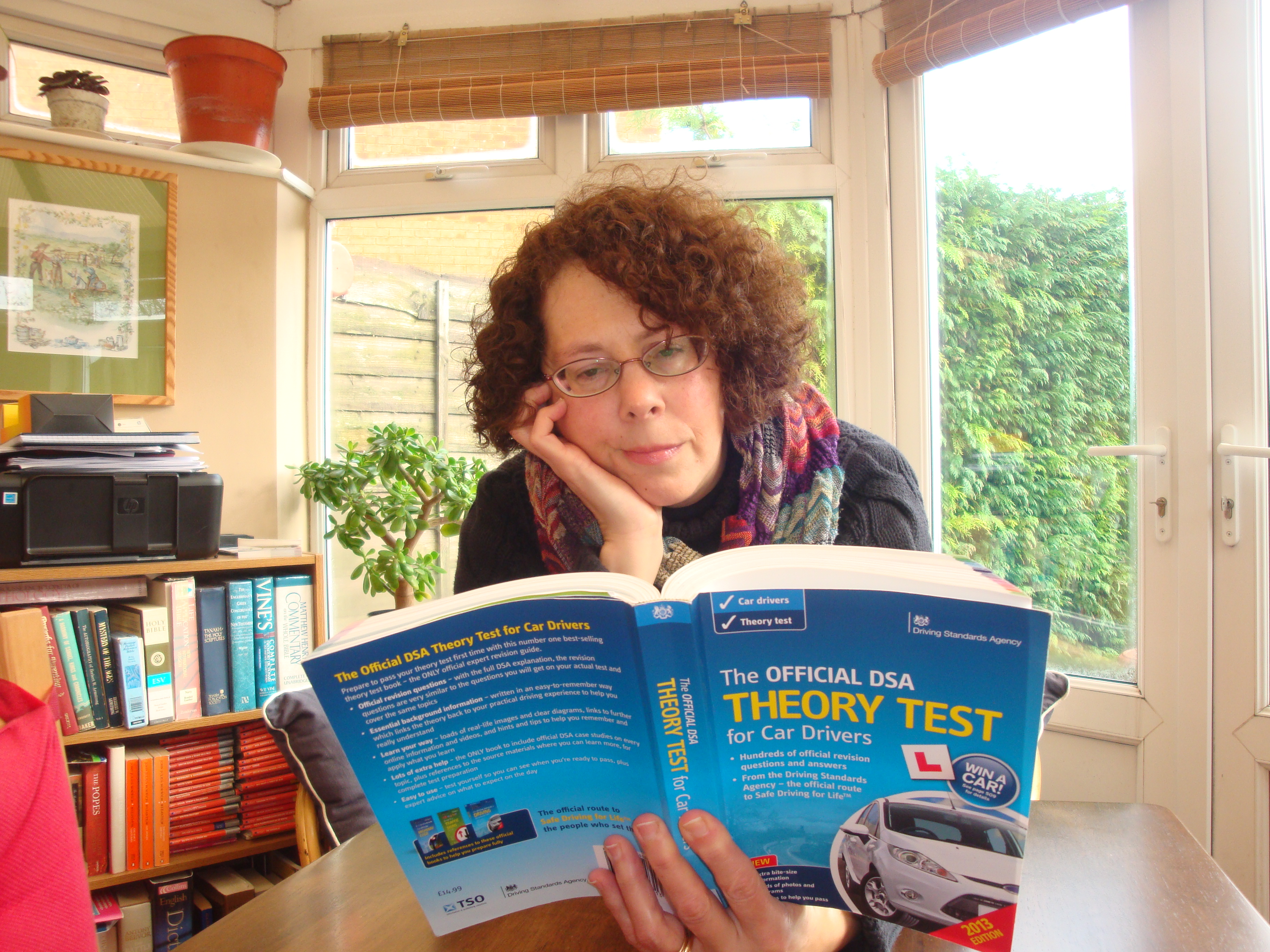
Those of us hailing from the United States have to submit to the full works. After being in the country for 12 months our US license is no longer valid and we are required to follow all the steps of a new driver in order to obtain a UK license. That involves:
- Applying for a provisional license. This is akin to a learner’s permit in the US, only you don’t have to take any sort of theory test before you receive it. You just fill out a form, pay a fee and submit proof of identification and residency, along with a grim photo that makes you look old and tired and definitely up to no good. No smiling allowed.
- Taking a two-part theory test – one part multiple choice questions, the other part the dreaded hazard perception test.
- Taking a practical driving test which an average of 50% of native-born drivers fail their first time around. The practical test involves an eye test, being asked one of several possible “show me” questions and a “tell me” question (show me how you check the oil, tell me how you test your anti-lock brakes), and then approximately 30 minutes of driving. And all the while that you are trying to remember to mirror-signal-manoeuvre, check your speed, change gears with finesse, the examiner is sitting in the passenger sheet making notes and ticking off every fault you make. If you make a major fault it’s all over, you have failed, but you can make up to 15 minor faults and still pass.
Very few people are able to pass the UK test without taking professional driving lessons, and if you read my previous blog you will know that I was no exception. Not only was I stressed out by driving on narrow roads where parked cars make it necessary to zigzag in and out, giving way to oncoming vehicles, but I had also never learned how to drive a manual transmission. Since our car is a manual it was not an option for me to take my test in an automatic. In the US it doesn’t matter if you take your test in an automatic and later purchase a manual car. You just go out to a huge parking lot and lurch around until you get the hang of it, and then away you go. Here in the UK things are different. If you want to ever be able to drive a manual transmission car you must – must – pass the driving test in a manual; otherwise your license will be endorsed to only allow you to drive automatics.
Mr. H attempted to teach me. After several lessons I was able to change gears successfully while in motion, but actually achieving propulsion remained tantalizingly elusive. I stalled the car more often than I care to remember, and was rapidly developing a loathing for first gear. I became convinced that learning to drive a manual car was beyond me. For the first time since learning to drive all those years ago I was becoming timid and frightened of getting behind the wheel. And so, at long last, the time came for me to take lessons.
After much searching around for recommendations and comparing prices we chose to go with one of the major national driving schools, in fact, the same driving school my husband had taken lessons with many years ago. When I learned the name of the driving instructor for my area it seemed too good to be true. His name was John Skidmore. If I had tried to invent a name for a driving instructor I could never have come up with something as perfect as that.
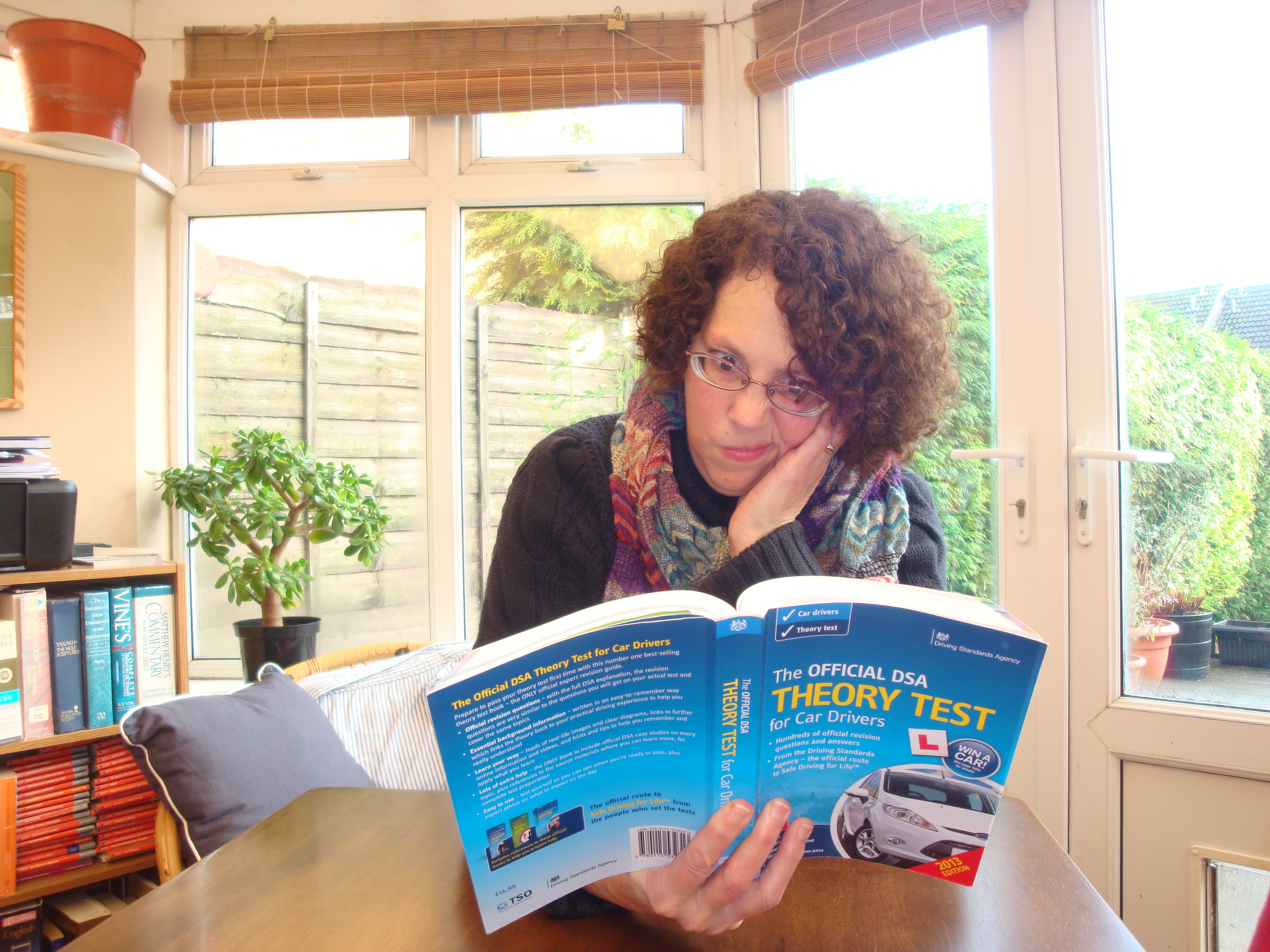
The day of my first lesson found me nervously pacing around my living room, sitting down to read a few more pages of the Highway Code, then springing up and pacing some more. It had been a year since I had last attempted to drive, a year of waiting for a problem with my ankle to heal so I could drive without pain, a frustrating year of sitting with my feet up, trying to be patient and often failing. At long last it felt that after months of stagnation my life was finally ready to go forward once again.
Somehow in my pacing and reading and springing I managed to miss the garishly painted driving school car pull up outside. It was painted all over with the name of the driving school, with giant red Ls for “learner” prominently displayed. There was nothing subtle about that car. It might as well have had “Get out of the way!” plastered all over it and flashing in neon.
My new driving instructor rang the front doorbell promptly at the appointed hour and introduced himself. (Although I mentioned his name previously, henceforth I shall call him J, since even my dear husband only gets an initial in these tales.) After a quick check to make sure all my documents were in order and to explain how our driving lessons would work, J drove us to a quiet neighbourhood nearby and parked. Thankfully it wasn’t the same quiet neighbourhood where Mr. H had taken me. This was a new area, untainted by my memories of failure. This was a fresh start.
After finishing the paperwork J had me read a number plate of a car to check my eyesight, and then it was my turn to get behind the wheel. After some explaining of the controls of the car J began with the basics of POM. In my previous existence POM was a brand of pomegranate juice, but now it came to stand for: prepare, observe, move. Under his guidance I started the car, pushed the clutch all the way down, put the car into first gear and gradually began to raise the clutch while giving the car some gas. A change in the sound of the engine and a slight lift at the front of the car told me I had found biting point. At last! The elusive biting point! After checking my blind spot I was ready to release the handbrake.
Oh, joy of joys, wonder of wonders! We were moving! We were actually moving! Only a few minutes into my first lesson and already I was driving. And it seemed so much easier than it ever had before. We made a short circuit around the neighbourhood and parked again by the side of the road. I had begun.
During that very first lesson J got me out of the quiet streets of the residential neighbourhood and onto the main road – real driving at last. I negotiated two roundabouts, a stop sign, turned off the main road and back onto it, and finally headed out of the village at the giddy speed of 50mph to the next town three miles down the road. I was terrified, and J kept telling me I was driving a little too far over to the left, but he said it calmly, without fear in his voice. It’s amazing what dual controls can do for one’s confidence.
That night, flushed with happiness and a welcome sense of accomplishment, I regaled my husband with tales of my driving exploits. He was surprised I had been allowed out onto the main road so quickly (oh, ye of little faith), but expressed that he’d had confidence in me all along.
And then he said, “I have to say that our car is very difficult in the low gears.” Well, thanks a lot. Why didn’t he tell me that before?
I wish I could say that it was all easy peasy after that, but it wasn’t. I still made plenty of mistakes, stalled the car often, got frustrated, cried and basically felt very stupid most of the time, but from that point on I made steady progress. I’m glad my driving instructor was not some young kid twenty years my junior. It was bad enough having my driving skills torn down to nothing and built back up from scratch; it would have been too much for my shattered morale to spend two hours each week being corrected and scrutinized and instructed by someone half my age. And would I have been brave enough to tell Junior I was having a hot flash? Probably not. J came to know when I needed the air conditioner turned full blast, and when I broke down and cried over a silly mistake he could talk me through it calmly. I probably drove him nuts (no pun intended), but he was very professional and very nice about it all, and most of all he was an excellent teacher. He prepared me thoroughly for each aspect of the test. Time and time again we drove around Chippenham, following all the possible test routes, encountering all the scenarios we might expect to encounter on the dreaded day, until at last he declared me ready.
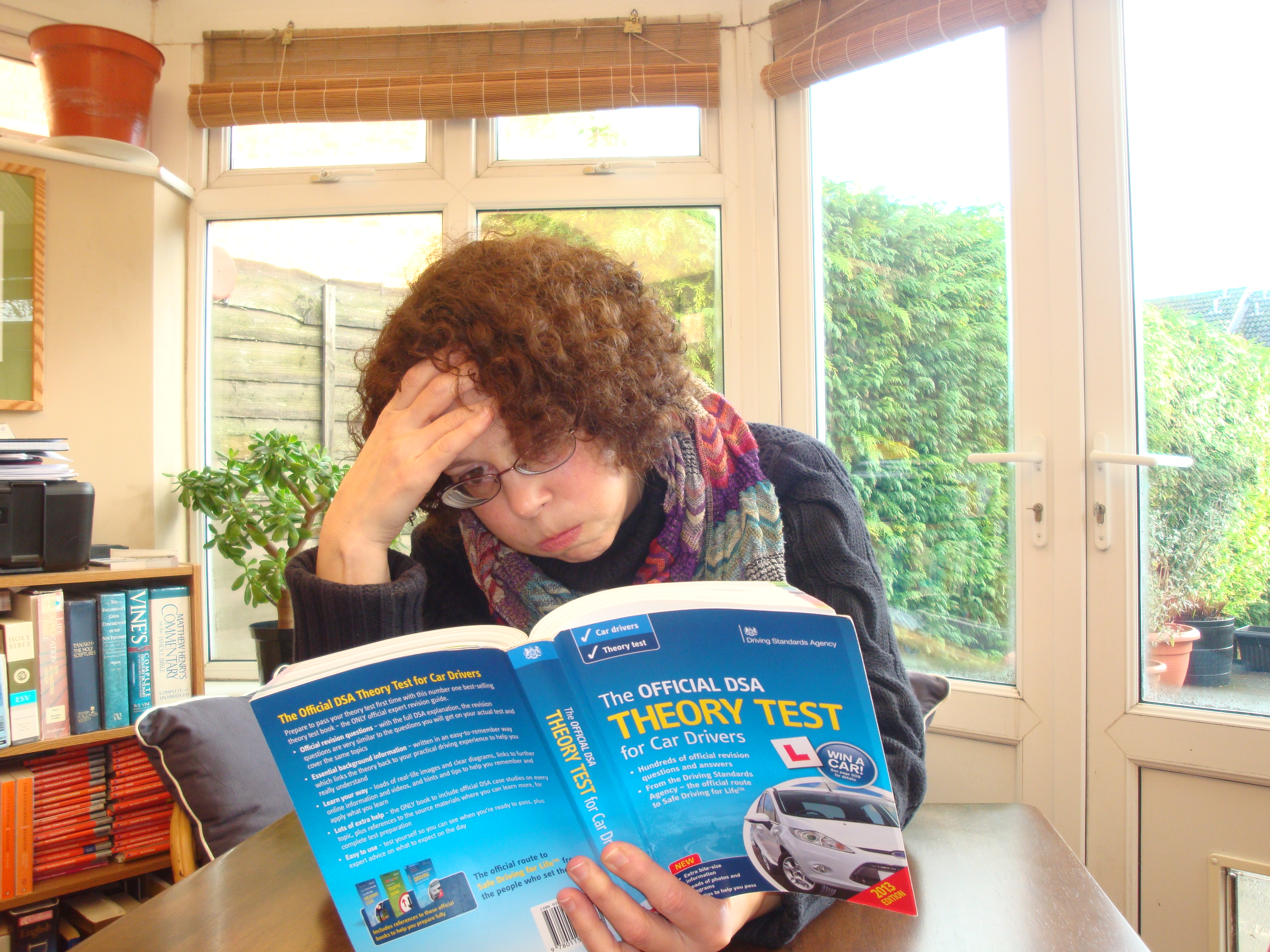
On the morning of my driving test Mr. H bade me farewell and told me he knew I would pass. I tried not to be sick.
During our hour of driving around town prior to my test J assured me that as long as I didn’t do anything monumentally stupid I would pass. I cried. Oh, how I hate those ready tears of mine. J pointed out that I was allowed fifteen minor faults during 30 minutes of driving. The odds of actually committing a fault every two minutes were slim to non-existent; so he said again, as long as I didn’t do anything stupid, I should pass. I was a nervous wreck. I kept thinking of the 50% who do something stupid and don’t pass. If all my driving lessons had taught me one thing it was that I have a bottomless well of stupidity to draw from. Never in my life have I dreaded a test as much as I dreaded the forty minutes or so of my British practical driving test.
Please, I thought, just don’t let the manoeuver be reversing around a corner. I hate that one. Please, let my examiner be having a good day. You don’t want your examiner to be suffering from toothache or going through a nasty divorce. You want someone who is at peace, someone who had a good night’s sleep and is looking forward to a lovely weekend ahead. (My test happened to be on a Friday.) I had the option of allowing J to ride along in the backseat, but that would have only heightened my anxiety. One person noting every wrong thing you do is nerve-wracking enough, two would be debilitating.
Finally the wait was over. My test was underway. I can’t even remember what my show me question was. It’s all a blur. I think the tell me question was about the headlights because I got flustered and used American terminology – high beam instead of main beam, main beam instead of dipped lights, but she said that was OK, she knew what I meant. Finally she instructed me, when I was ready, to go ahead and drive on. Before we were even down the side road where the exam centre was located I knew I had already committed a fault by getting flustered by an approaching lorry and not giving way properly, but I had to keep focused on what I was doing and let that go. As we approached the main, busy roundabout she told me,
“Follow the signs for town centre.” The independent driving portion of the test had begun.
It was gruelling. By the end of the thirty or so minutes of the test I was exhausted, but I had one more element to complete before it was over. So far I had not been asked to perform one of the four possible manoeuvers, so I knew that by default that meant I would have to reverse into one of the parking bays at the front of the examination centre. Thankfully with J’s instruction I had done just that when we parked before my test, so I knew exactly how to line the car up and reverse into the end bay. Finally I set the handbrake, placed the car in neutral and turned off the engine.
J was at the passenger side door almost immediately. We were the last of the three cars out on tests to return, so no doubt he’d been suffering a bit of anxiety wondering just how deeply I was tapping into my well of stupidity. The examiner asked if I wanted her to go over my test with me in private, or if J could listen in. Of course I said J could listen in since he would be the one having to help me correct my errors so I could pass the next time. I didn’t say that, but I was thinking it. I was sure I must have failed. I had hesitated too long when turning out into a busy road, and I had changed gears clumsily a few times. Mentally I was kicking myself for all the idiotic things I had managed to do during my test. I was hopeless. I was the worst driver, ever.
“You passed.”
What? I passed? Oh, how quickly despair can turn to joy. I had passed, and without as many faults as I’d expected. My tension-numbed brain could barely comprehend the amazing, wonderful truth, but when it did the tears welled up uncontrollably. Even J, I could tell, was incredibly relieved. It was only as he drove me back to our drop-off location that he told me that for the past seven months every single one of his students had passed their tests on their first attempt. He had probably been afraid I would break his winning streak. But I didn’t. I passed.
I PASSED!
I have now joined an elite – or at least, what used to be an elite – echelon of drivers. I can hold my head high and drive with assurance knowing that I have passed one of the most rigorous and exacting driving tests out there. And when someone does something stupid out on the roads I can shake my head and mutter, “Crazy Bulgarian drivers.”
***
Three years ago my husband uttered four words which tilted my world on its axis. Those words were, “I bought a car.” Not just any car, but a diesel car with a manual transmission. And so began my journey into the unknown. Once more, kicking and screaming and leaving claw marks behind me, I was dragged into making change that I didn’t want to make. Once more I had to learn something I was not eager to learn. Once more I learned that with hard work, study and practice the impossible can eventually become possible, the difficult can become second nature.
Three months ago my husband and brother-in-law sat hunched over their laptops, searching railway websites for the best schedules and fares from our home to Gatwick Airport. My sister and niece were staying a week longer than my brother-in-law, and we needed to find the best way to get them back to the airport on a day when Mr. H had to be at work. When Mr. H saw how expensive the rail fares were he was outraged.
“You’ve got to be joking!” he said with scorn. “You’re not paying that. Elizabeth can drive them.”
Elizabeth can drive them. Just four words, yet with those four words my world, which had been slightly off kilter for nearly three years, was suddenly right side up again. I had regained something precious which had been lost, and which I had been quietly yearning for all this time. Although I was intimidated at the thought of driving over a hundred miles from my home to London, down some notoriously busy motorways, I also knew that I could do it.
And you know what? I did.
“It is not in the still calm of life, or the repose of a pacific station, that great characters are formed. The habits of a vigorous mind are formed in contending with difficulties.” ~ Abigail Adams

 An American Wife in Wiltshire
Very interesting and entertaining, keep it up.
Thank you for the encouragement. I enjoy writing these blogs and appreciate hearing that others find them interesting.
Miss Lizzie…you can drive me anywhere! As always…Love your blog!
Thank you, Nancy. Beware, when you come visit I will be driving you.