

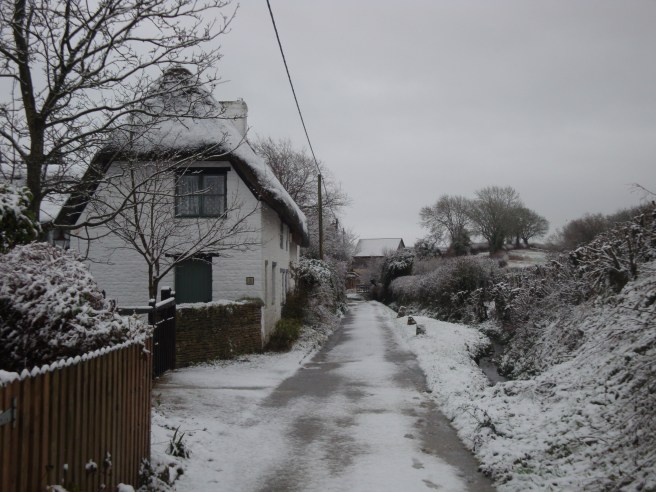
The sound of steady dripping emanated from the bathroom where my sodden raincoat was hanging up in the shower to dry. The hollow drip, drip, drip as the water hit the tub below created a syncopated counter-beat to the drumming of the rain on the roof above my head. The world can be a dank, dark, dreary place in the depths of an English winter.
On days like this, when the rain falls relentlessly, a question asked by a visiting American friend comes to mind. It was the third day of her visit, and the third day of intermittent showers. She turned to me and asked, “Doesn’t the unrelenting gloom get depressing after a while?”
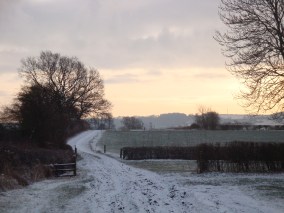 Quick to rush to the defense of my adopted country, I pointed out that the gloom isn’t unrelenting – that there are often moments of pure breathless wonder when the clouds part and blue sky suddenly appears. It may only last for moments, an hour or two, or if you’re lucky an entire day, but for that brief span of time the birds sing their songs of springtime and the countryside has a pure, crystalline beauty that is awe inspiring.
On that particular morning I set out to walk the dog in hopes of being rewarded with at least a fleeting glimpse of blue sky. For days the hills to the east of us had been enveloped in murk and fog, but at long last they were visible again. Buoyed by this apparent sign of clearing weather I opted against putting on the noisy waterproofs that go swish, swish, swish when I walk.
That was a big mistake.
One moment my dog and I were meandering along minding our own business, the next we were trapped in a deluge. The rain didn’t just fall, it cascaded in a torrent and was blown sideways by the wind. Backed up drains quickly overflowed and streams began running down both sides of the road. Within a minute my jeans, my shoes and my socks had all soaked through. All we could do was lean into the wind and battle our way home. By the time we arrived both dog and human resembled wet dishcloths that needed to be wrung out.
In Scotland they have a word for it: dreich. It means dreary or bleak, and wintertime in the UK is often very, very dreich.
After I’d towel-dried the dog and changed into warm dry clothing, on a whim I pulled my old, much loved copy of Anne of Green Gables from the bookshelf and began thumbing through it. And there I came across a quote which made me pause for thought.
“That’s the worst of growing up, and I’m beginning to realize it. The things you wanted so much when you were a child don’t seem half so wonderful to you when you get them.” – Anne of Green Gables
I grew up in sunny San Diego, California where the average year-round temperature is a pleasant 72o Fahrenheit (that’s about 22o Celsius for you Brits). San Diego is a beautiful place, a slice of the California good life, and it was a privilege to be able to grow up there. We slathered ourselves with coconut-scented deep tanning oil and spent afternoons at the beach or went roller skating in Balboa Park. We wore shorts and went barefoot nearly year-round. It was a childhood spent in a seemingly idyllic setting.
Does it follow therefore that I was content? Call me contrary, or just call me human, because in spite of the perfection of the area I longed for something else, and some of the blame for my feelings of discontent can be placed squarely on the shoulders of little Anne Shirley of Green Gables.
Sitting cross-legged on the couch in my father’s house on a sunny day, with the windows  all open and the birds chattering away outside, I immersed myself in the beautiful descriptions of Prince Edward Island. Although surrounded by the beauty and vivid colours of Jacaranda trees and bougainvillea vines, I dreamed of apple blossoms and lilacs. I longed to experience all four seasons rather than year-round summer, to experience the thrill of bulbs emerging from the bare earth after a long, cold winter.
Yes, I was an odd child.
Now there come days in the midst of bleak midwinter when my sister complains about the weather in California (It’s going to be 80 degrees again!) while I’m wearing my thermals and two sweaters to keep warm – and that’s just indoors – that I’ll think, “Be careful what you wish for, you just might get it.”
At these northern latitudes December days are depressingly short, and when our few daylight hours are shrouded in clouds and gloom it can often feel like winter is going to last forever. It can rain fiercely and blow a gale, it can snow and sleet, and almost worst of all, mist and drizzle can just hang about, swirling endlessly, infiltrating every pore with damp the moment you step outside.
Just when you think you can’t take it any longer and start searching for holiday deals to the Caribbean, you notice a few green shoots poking up out of the leaf mulch of the previous autumn. By mid-January the snowdrops are up and budded, and by February the flowers of hope have arrived along with longer days, signalling that winter’s back is broken and spring will soon be here again.
In the US I’d only ever thought of snowdrops as a garden flower, so it was surprising during my first winter here to see masses of them growing wild in the countryside. Where did they come from? Were they genuinely wild or did they grow in forgotten overgrown gardens, rather like the old lilac bushes in New England that mark the sites of long abandoned Colonial homesteads? Was there a British version of Johnny Appleseed, Susie Snowdrop perhaps, who had long ago travelled throughout the land planting bulbs?
The truth is even stranger than that.

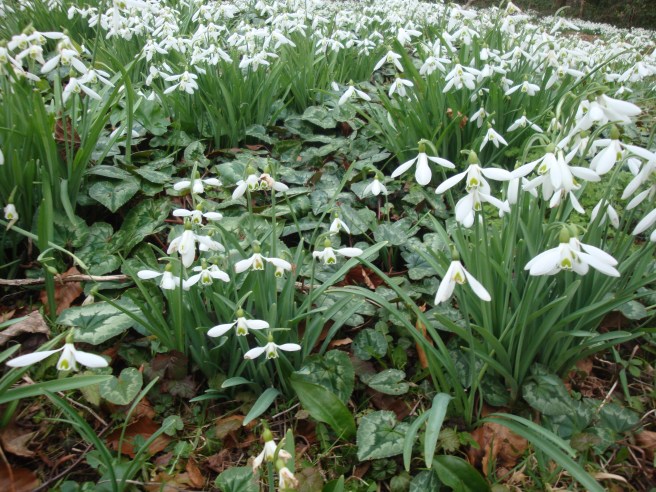
Snowdrops are not actually native to the UK, and the first bulbs are thought to have been brought here from Europe around the 1770s. Although not native, the UK does provide ideal growing conditions for the bulbs since they like damp woodlands and chalky soil. How they have managed to spread so profusely in the wild is fascinating. When their flowers open in late winter they provide much needed food for the bees which pollinate the flowers. Once pollinated the snowdrops then produce seeds with fatty, protein rich elaiosomes attached. Foraging ants pick the elaiosomes and carry them underground to feed their larvae, thereby helping the flowers spread out to new areas.
Thanks to the hungry bees and ants we can now drive down our country lanes and witness the late winter spectacle of a carpet of white bringing the hope of springtime to our dreary, late winter landscape. Spring is nearly here, and then summer, and once more we will revel in our long days of sunshine made all the sweeter because we endured another arduous winter. As Anne Shirley said, some of the things we long for as children aren’t nearly as wonderful as we think they will be when at last we obtain them, but experiencing the four seasons definitely is. There is something to be said for a land of perpetual summer, but it is only the hardships of winter that reward us with the perfection of snowdrops.
The flowers of late winter and early spring occupy places in our hearts well out of proportion to their size. ~ Gertrude Smith Wister


 An American Wife in Wiltshire
Dear Elizabeth,
Am writing a novel and collecting “tingle-making” lines from authors I read. Have several from D. Gabaldon, Sara Donati, Thomas Jefferson Farnham, Linda Lay Shuler, Jessemyn West, Louise Erdrich, ELIZABETH HOSTICK HURD and more. When I dive in and start writing I often get into dullsville. I know I will need to go back and revise, polish and shine the d….thing up anyway, but I love it when I write something somewhat aesthetic the first time that I know I will keep! So I find if I read my quotations or some great poetry before I dive, I get more into a poetic “groove” and my writing is much more gratifying to me. So thank you for your inspiration! When will we see your words being grabbed off the shelves in airports across the nation?
Marilyn
>
Thank you Marilyn. Good luck with your novel. I’ll look forward to reading it someday, and hopefully someday you’ll be able to ready my book as well.