“November is the most disagreeable month in the whole year”
~ Louisa May Alcott, Little Women
People often complain about the dreariness of November. Mr. H is not a grumbler in general, but he does often grumble about November. There is something monotonous and even depressing, here in England, about the onset of the dark months. The days are still growing shorter, it is getting colder, the winds whip the last of the dry, brown leaves off the trees and the rain – oh, the rain – it comes down sideways in gales, or it swirls around in the gentle air currents, creeping underneath our hoods and brollies. The rain can be unrelenting, and yes, the month can feel very disagreeable, indeed.
Now and then, however, we are given a precious, unexpected gift. We wake to a morning turned white and frozen. The house feels like clammy tomb when we haul ourselves out of bed and race for the warmth of the bathroom, but there is a little tingle of hope stirring in my heart. The question of the day is: will the mud be frozen solid out in the fields?
Yesterday was one of those days. No, the cold is not all sunshine and happy musical show-stoppers. My morning started with me having to suck the moisture off the inside of my windows with my bright yellow window vacuum. Imagine a squeegee attached to a battery operated vacuum with a water tank. It sucks up all the condensation that collected on my windows during the night, saving me having to use a cloth, which would then need to be dried, releasing more moisture into the air needing to be sucked off the windows tomorrow.
We have a twenty-litre dehumidifier running upstairs outside out bathroom almost 24/7 during the cold months, but it is still a constant battle against damp.
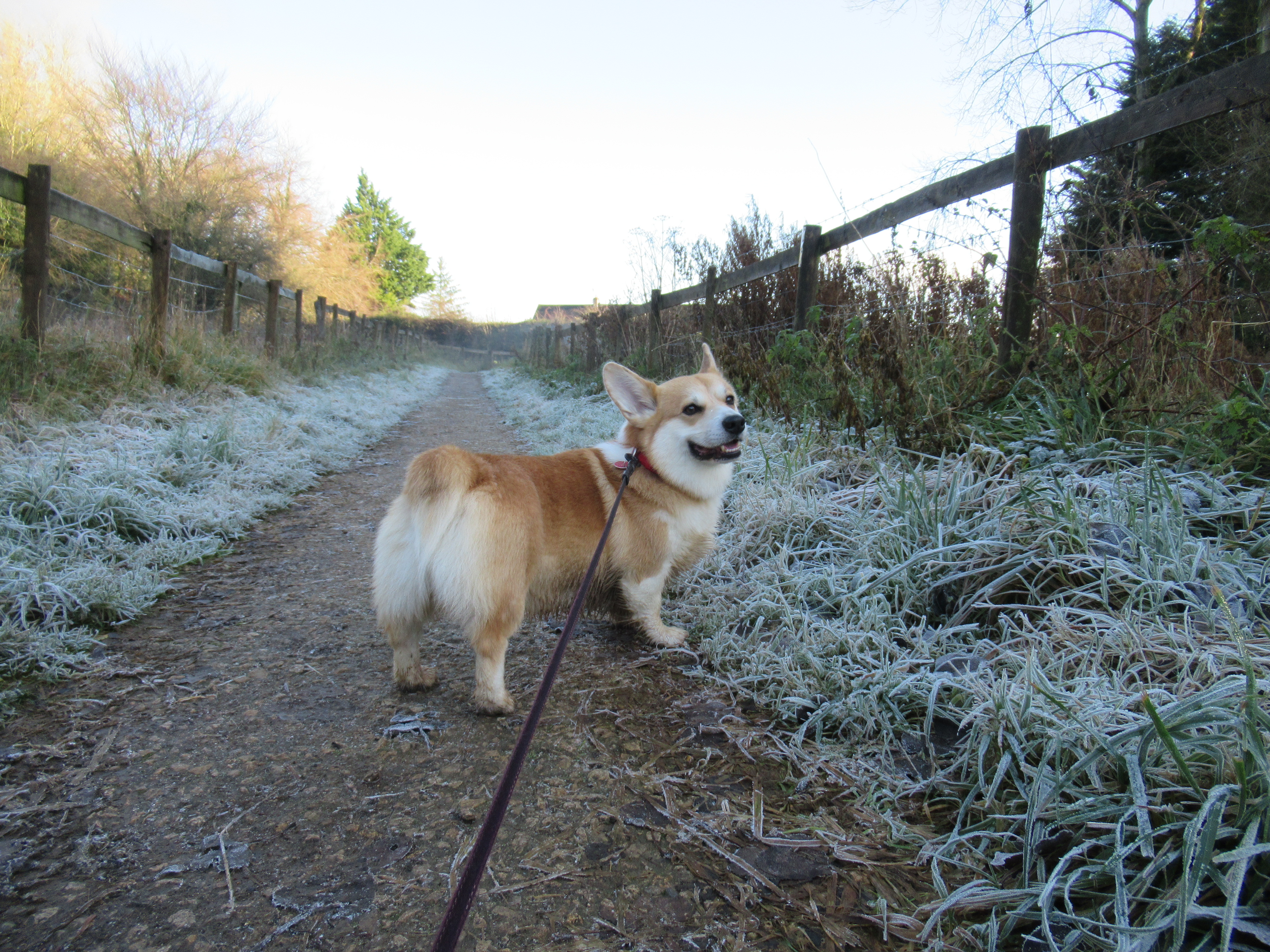
Nevertheless, my mood undampened by my dripping house, after breakfast I geared up in a thick coat, woolly hat, scarf and gloves, snapped Jethro’s leash on, and together we headed up to the gap at the end of our street that opens onto the fields behind our housing estate.
Our footsteps crunched on the frozen mud as we made our way up the first field. It was slow going as Jethro, in his usual morning fashion, had to stop and sniff out all the latest news left behind by previous passers-by. This field has been left uncultivated for many years, and is now quite a wild, overgrown place, frequented by foxes, deer, cats and all manner of tiny creatures, as well as many of the local dogs out for their morning exercise. There is much information to be collected, and to be left, by my small companion.
At the top of the field we passed through the gap in the hedges into a second field, which is the beginning of what Mr. H and I call, “The Farm Loop”. Field follows after field here, with thick hedgerows surrounding them, all the way to the steep ridge to the east of us, and through and around the fields are ancient rights of way, footpaths and bridle paths where we can walk freely. The length of our walk often depends on the weather, how muddy it is, and how much time we have. We might do the two-field loop, the three-field loop, or the Big Loop, as I decided to do.
The sun was rising higher, warming the ground just enough to form a thick fog above the frosty fields. Birds flitted among the branches of the oak trees as we passed beneath, my boots crushing hundreds of acorns scattered below. It was a good year for acorns. We’d never seen quite so many, which could mean we are in for a cold winter.
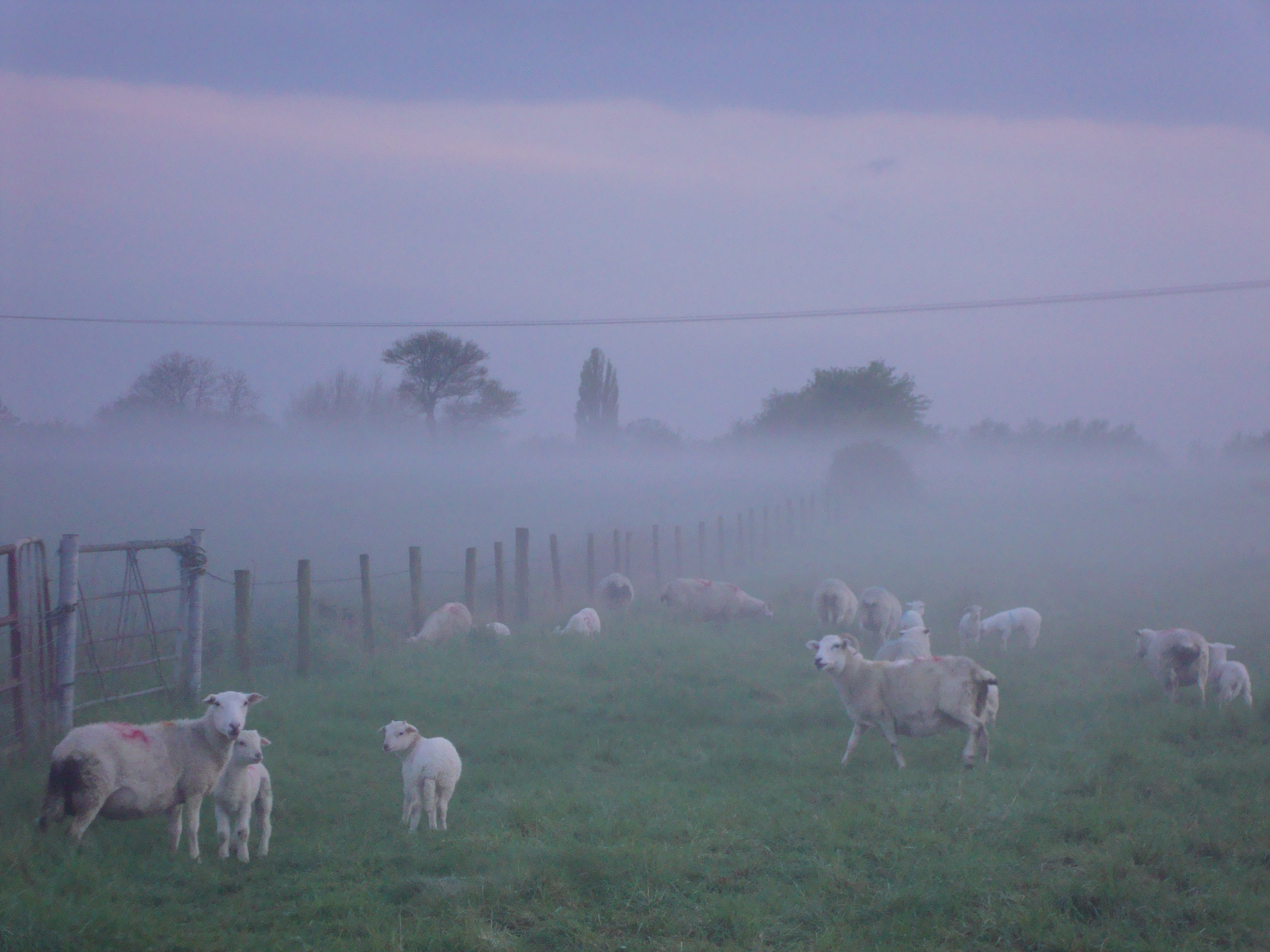
At the top of a small rise, six long fields from home, I stopped to look back at the gently rolling countryside. The cows have been taken into the barns for the winter, but the sheep have now taken over. They eyed us suspiciously. Cows are curious and will crowd eagerly up to the fence line to gaze at Jethro in astonishment, especially the younger ones, but sheep are never curious. They are nervous. They are suspicious. They do not trust foxy little dogs with big ears. They do not like the cut of his jib one bit, and they all turn their backs on us and walk away, glancing back to be sure we are not following.
The fog was lifting now and the sky turned a deep, intense blue. Nearby, water burbled down a stream. The smell of wood smoke rising from the cottage at the bottom of the hill tickled my nostrils. The still, cold air was punctuated by the raucous squawks from a rookery several fields away. Down on the road I could see the milk lorry winding its way up from one of the dairy farms, rumbling as it changed gears to climb the small hill. But in spite of these sounds, there was a stillness that was incredibly calming.
As we walked on, past puddles frozen in the tractor tyre ruts, my thoughts turned to Thanksgiving, and as is so often the case these days, what a marvel it is that I am alive and able to celebrate it another year. Two years ago, it was a different story. Two years ago I was dying.
Two years ago I was waiting for a transplant, and without it I was not going to make it much longer. Nine years ago I was diagnosed with a very rare, incurable disease called Primary Sclerosing Cholangitis. I lived my life, as best I could, always aware that there was something going in inside me that was inevitable, and that I had no control over. There is no cure and, so far, no treatment that will reverse the effects of PSC. There is promising new research being done, and some positive results in clinical trials of a possible treatment, but so far, it is too early to tell. But for me, any cure would come too late.
PSC is a disease which seems to affect people who already have an autoimmune disease, usually some form of IBD like Crohn’s or ulcerative colitis. In my case, it was the latter. It is still not known why, or what, exactly causes it, but it causes scarring in the bile ducts and liver. When the scarring becomes so severe that liver failure is imminent, the only treatment is a liver transplant.
Almost two years ago, in early 2024, I received my life-saving transplant. I am alive, and while my family rejoiced and celebrated and gave thanks, somewhere another family grieved, but made the decision in their grief, to help others.
So, as my little dog and I walked alongside the stream, through the tiny hamlet with its thatched roofed cottages and giant willow trees, I gave thanks. I give thanks every day.
I give thanks for my wonderful husband, who is my best friend and dearest companion, and who supported and strengthened and encouraged me through my darkest hours, even managing to make me laugh a fair amount of the time. I give thanks for my extended British family, for their love and support, and for my American family who called me every day and were there whenever I needed to cry or rage. I give thanks for the people I didn’t know who heard of my situation and offered help and support. I give thanks for the little dog who pads quietly beside me, who slept next to me on the couch on the days when I was too tired and weak to do anything. I give thanks for the doctors and nurses who didn’t give up on me, even though my case was a complicated one. And I give thanks, every day, for that family I will never meet and the person I will never know, who gave me such a precious gift.
I am alive. I am blessed. I am full of gratitude and joy every day. Life is undeniably bleak and horrible at times. We all go through Novembers of the heart and mind. But I think taking a day to think about all we have to be grateful for helps us to see and savour the incredible beauty and wonder there still is in every day.
Yes, November does tend to be a dreary month here in England. But it is a month that, for me at least, comes with a reminder to look back and take note of just how much there is to be thankful for.
“It is not joy that makes us grateful. It is gratitude that makes us joyful.”
Dear friend Elizabeth , co-heir and sojourner, Thank you for your beautifully descriptive and lovingly phrased and encouraging (always) episode of your life with Ian


 An American Wife in Wiltshire
Dear friend Elizabeth , co-heir and sojourner, Thank you for your beautifully descriptive and lovingly phrased and encouraging (always) episode of your life with Ian
Thank you for your support and mentorship through the years.